About Ficedula nigrorufa (Jerdon, 1839)
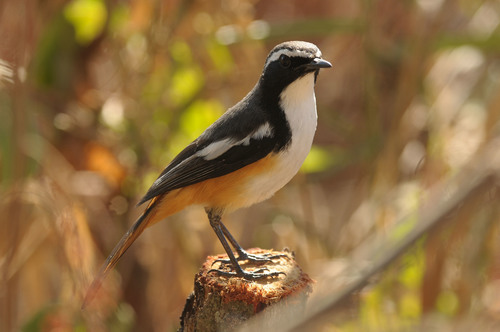
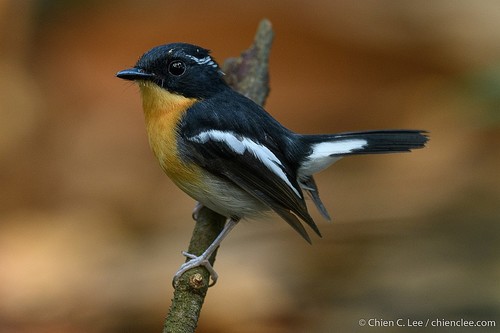
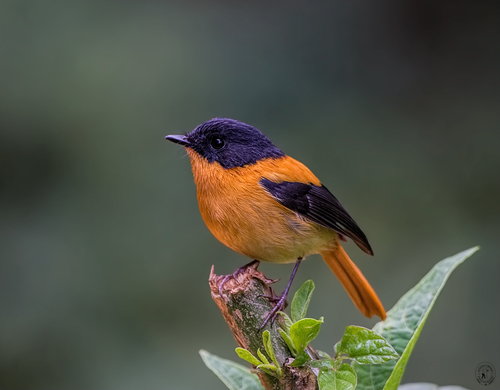
Ficedula nigrorufa, also known as the black-and-orange flycatcher, is a distinctively colored bird found mainly in high-elevation areas of the Western Ghats, the Nilgiris, the Palnis and associated hill ranges. Males have distinctly black heads and black wings; in females, all black plumage is replaced by dark brown, and females have a light eye-ring. Individuals are usually seen alone or in pairs. Two-week-old young birds are brownish orange with a whitish vent and abdomen. Their heads have dark streaks, their wings appear bluish with a trace of brown, they have a pale ring around the eye, and their orange tail is stumpy. Eight weeks after fledging, young birds look almost identical to adults, except for patches of brown feathers on the crown. The main population of this species is found on high elevation plateaus above 1,500 m (4,900 ft) in the Nilgiris, Palani Hills, Biligiriranga Hills (Bellaji and Honnametti), and Kannan Devan Hills. They prefer areas with thick leaf litter and undergrowth in open shola grassland habitats. During the breeding season, the population density corresponds to approximately one pair per 2.8 ha (6.9 acres). It is a highly parochial bird, and no local movements other than juvenile dispersal have been recorded. To the north, it occurs in Kudremukh National Park and the Bababudan Hills, and it ranges south to the Ashambu Hills. Some older records of this species from Maharashtra and Sri Lanka are considered dubious. Breeding occurs from March to May; during this season, the birds are very vocal, producing a repetitive "chee-ri-rirr" or a whistling song "whee-chee-ree-rirr". They feed on insects by flycatching low over the ground (under 2m in height) and also pick insects directly from the ground. A breeding pair maintains a territory year-round. When performing a threat display, the male points its bill upward, fans its tail, opens its wings, and produces "keet-keet" calls. The alarm call of the species is a zit-zit. Males usually handle territorial defense, but females will sometimes join in. The female builds the nest, which is placed in a low bush or fern. The usual clutch size is two greyish eggs covered in dark speckles. Hatchlings are brownish and speckled. Unlike the nests of most flycatchers, this species' nest is large, coarse, and ball-shaped, constructed from sedges. It has a base layer of dry leaves and ferns. The external diameter of the nest measures about 6 inches (15 cm). The unlined egg cavity inside is about 2 inches (5.1 cm) in diameter and 2 inches (5.1 cm) deep. Nests are usually placed at the center of a bush around 1 to 3 feet (0.30 to 0.91 m) above ground, with an entrance hole near the top of the nest. This flycatcher has peak feeding activity early in the morning and around dusk. During these periods, it captures up to 100 insects per hour, while it is half as efficient at foraging during midday. Along with the rufous-chested flycatcher (Ficedula dumetoria), this species is one of only two sedentary species in the genus Ficedula, and it lacks the longer, more pointed wing shape seen in long-distance migratory members of the genus.