About Ficedula mugimaki (Temminck, 1836)
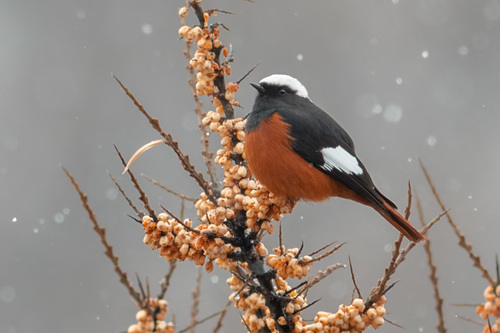
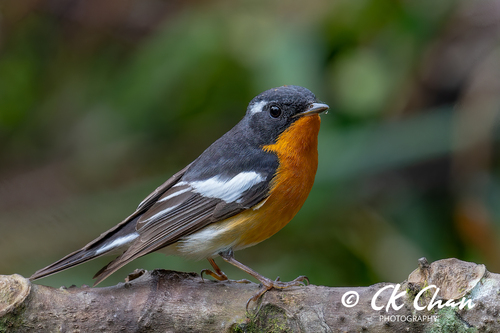
The mugimaki flycatcher, Ficedula mugimaki, measures 13 to 13.5 centimetres in length. It produces a rattling call, and often flicks its wings and tail. Adult males have blackish upperparts, a short white supercilium behind the eye, a white wing-patch, white edges to the tertials, and white coloring at the base of the outer tail-feathers. An adult male’s breast and throat are orange-red, while its belly and undertail-coverts are white. Females have grey-brown upperparts, and pale orange-brown coloring on the breast and throat. Females have no white in the tail, and have one or two pale wingbars instead of a white wing-patch; their supercilium is either faint or absent entirely. Young males are similar in appearance to females, but have a brighter orange breast, white in the tail, and a more obvious supercilium. This species breeds in eastern Siberia and north-east China. Migrating individuals travel through eastern China, Korea, and Japan during both spring and autumn. It winters in Southeast Asia, reaching as far as western Indonesia and the Philippines. There is one confirmed record of a vagrant individual on Shemya Island, Alaska, in 1985. A bird observed in Humberside, England in 1991 was not accepted as a wild bird into Category A, and was instead placed in Category D, indicating it was likely of captive origin. It remained in Category D after a 2009 review, and was moved to category E following a third review in 2016. Its primary habitats are forest and woodland, particularly at higher elevations. It can also be found in parks and gardens during migration. It typically occurs alone or in small groups, and feeds on flying insects in the tree canopy.