About Ficedula hypoleuca (Pallas, 1764)
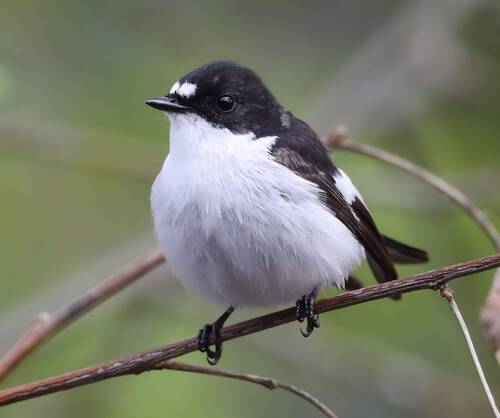
Ficedula hypoleuca, commonly called the European pied flycatcher, is a bird species that measures 12–13.5 centimetres (4.7–5.3 in) in length. Breeding males are mainly black on the upper body and white on the lower body, with a large white wing patch, white tail sides, and a small forehead patch. The Iberian subspecies F. h. iberiae, also known as the Iberian pied flycatcher, has a larger forehead patch and a pale rump. The black colouring seen in breeding males is replaced by pale brown in non-breeding males, females, and juveniles. This species can be very difficult to distinguish from other Ficedula flycatchers, particularly the collared flycatcher, and hybridises with this related species to a limited extent. Its bill is black, with the broad but pointed shape that is typical of aerial insectivores. In addition to catching insects while in flight, this species hunts caterpillars in oak foliage, and will also eat berries. Because it forages in foliage as well as catching prey in flight, it is a much earlier spring migrant than the more strictly aerial spotted flycatcher. Its loud, rhythmic, and melodious song is characteristic of oak woods in spring. Its contact and alarm call is a series of short whistles, described as 'whit, whit, whit'. This species lives in deciduous woodlands, parks, and gardens, with a preference for oak trees. It builds an open nest in a tree hole, and readily adapts to using open-fronted nest boxes. Females lay 4–10 eggs per clutch. The European pied flycatcher has a very large range and population size, and the IUCN has classified it as a species of least concern. Its breeding range covers multiple countries across Europe and northern Africa, and also extends into the west Asian portion of Russia. Three recognised subspecies occupy distinct parts of this range: the nominate subspecies F. h. hypoleuca lives in the UK, central Europe, and Scandinavia; F. h. iberiae inhabits the Iberian Peninsula; and F. h. tomensis lives in eastern Europe and Russia. The species occurs as a vagrant in parts of other countries in Africa and South Asia, including Sudan and Afghanistan. It typically spends the winter in tropical Africa. This is a terrestrial bird that generally inhabits open forests, woodlands, and towns. In 2005, the European population was recorded as holding 3–7 million breeding pairs.