About Festuca vivipara (L.) Sm.
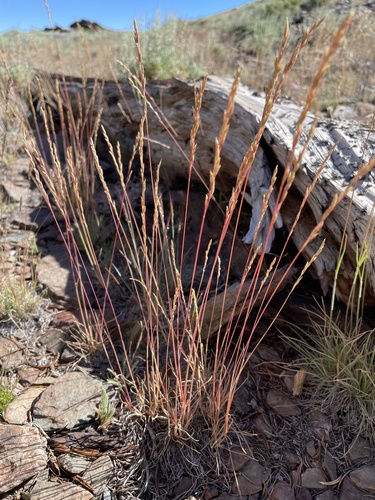
Festuca vivipara (L.) Sm. is a perennial grass that grows in dense tufts, reaching 5–20 cm (2.0–7.9 in) in height with thin, hair-like capillary culms. Its internodes are either hairless (glabrous) or slightly covered in fine short hairs (somewhat puberulent). Dead leaf sheaths on this species either remain attached to the plant or shred into fibers, while living leaf sheaths have a purple tint and a prominent midvein. A distinct swelling occasionally marks the auricle. The erose (irregularly toothed) ligule measures 0.2–0.5 mm (0.0079–0.0197 in) in length. The setaceous (bristle-like) leaf blades are somewhat stiff; the flag leaf blade is around 0.5–2.5 cm (0.20–0.98 in) long. When viewed in cross-section, leaf blades are typically 0.5–0.9 mm (0.020–0.035 in) wide and 0.25–0.6 mm (0.0098–0.0236 in) thick. In cross-section, sclerenchyma tissue is arranged into three large bundles and up to four smaller bundles. Adaxial (upper-side) sclerenchyma ranges from being partially developed along the leaf margin to forming a thick subepidermal band.
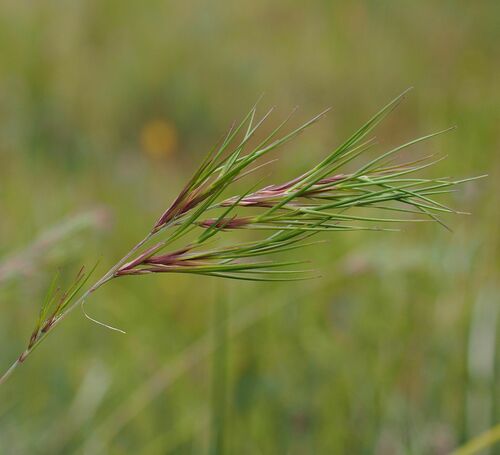
This species produces strongly proliferous, compact panicles that are 2–10 cm (0.79–3.94 in) long, with flowers that develop as leafy tufts. Its purplish spikelets measure 0.7–3.5 cm (0.28–1.38 in) long. The glumes are much shorter than the spikelets and have erose margins. The lower glume is 2.0–4.5 mm (0.079–0.177 in) long with one vein, while the upper glume is 3–5 mm (0.12–0.20 in) long with three veins. Unmodified membranous, awnless lemmas are 4–6 mm (0.16–0.24 in) long and strongly rolled inwards. Paleas are either absent or reduced. When present, lodicules are toothed and lack hairs. Festuca vivipara flowers from July through early August.
In terms of distribution and habitat, Festuca vivipara occurs in North America from Greenland and Labrador to Alaska, where it grows on calcareous rock and peat. It can also be found in western Newfoundland, the Shickshock Mountains, and parts of Quebec. Outside of North America, it grows in northern Europe and Russia, near lakes and streams.