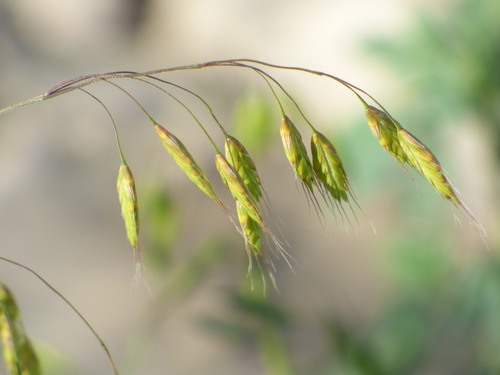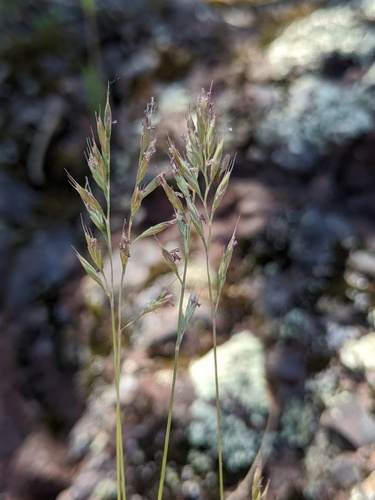
About Festuca saximontana Rydb.
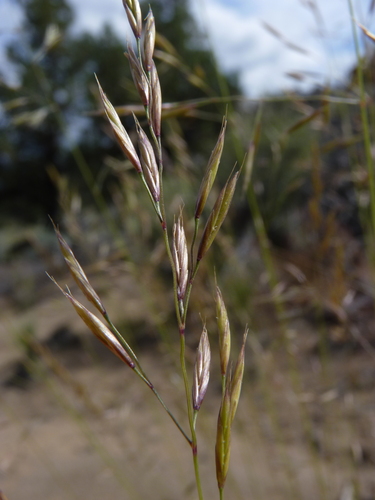
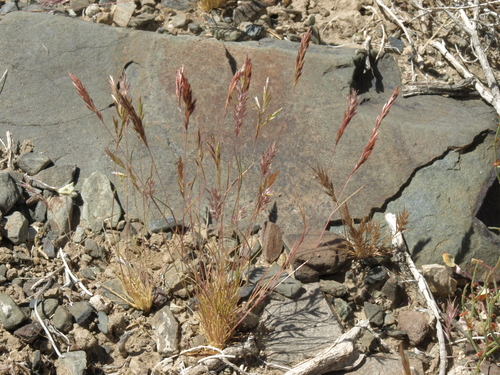
Festuca saximontana Rydb. is a densely tufted grass ranging in color from bluish-grey to green, and it does not grow rhizomes. Its culms are smooth and glabrous, occasionally scabrous, and reach 7–70 cm (2.8–27.6 in) in height. Culms sometimes become puberulent just below the inflorescence. The leaf sheaths are glabrous, either smooth or scabrous, closed for half their length, and occasionally become shredded. Dead leaf sheaths remain persistent at the base of the plant. Erose ligules of this species measure 0.1–0.5 mm (0.0039–0.0197 in). The conduplicate leaf blades are 0.5–1.2 mm (0.020–0.047 in) in diameter, with glabrous abaxial surfaces and scabrous adaxial surfaces. Abaxial sclerenchyma is made of three to seven strands that form a continuous band, while adaxial sclerenchyma is absent. Flag leaf blades measure 0.5–4 cm (0.20–1.57 in) long. The panicles are mostly linear-cylindrical, and occasionally loosely lanceolate, and grow 2–10 cm (0.79–3.94 in) long. One or two erect branches grow from each node of the inflorescence; these branches become nodding during anthesis, and measure 0.5–3 cm (0.20–1.18 in) long. The greenish spikelets are loosely flowered, hold three to five florets, and measure 4.5–8.8 mm (0.18–0.35 in). The coriaceous glumes are lance-subulate, and become scabrous at their distal end. Lower glumes measure 1.5–3.5 mm (0.059–0.138 in) and have one vein, while upper glumes measure 2.5–4.8 mm (0.098–0.189 in) and have three veins. The coriaceous lemmas are strongly curved; the longer lemmas measure 3–5 mm (0.12–0.20 in) long. Awns of this species measure 1–2 mm (0.039–0.079 in). Paleas measure 3–5 mm (0.12–0.20 in) long, and anthers measure 1.2–1.7 mm (0.047–0.067 in) long. For distribution and habitat, Festuca saximontana grows in dry or mesic grasslands, woodlands, and sand dunes across boreal, mountainous, and subalpine regions of North America, at altitudes below 3,600 m (11,800 ft). Its range extends from Alaska to Greenland, south to California and New Mexico, and east to the Great Lakes; it is rarely found in the Russian Far East. It has a slightly more southern distribution than Festuca brachyphylla, and does not occur in the Arctic Circle or some parts of the Canadian archipelago. In ecology, Festuca saximontana acts as a host plant for the western branded skipper and the draco skipper.