About Festuca occidentalis Hook.
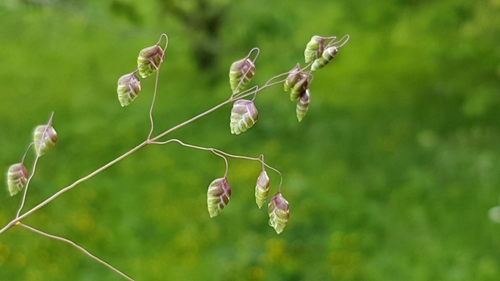
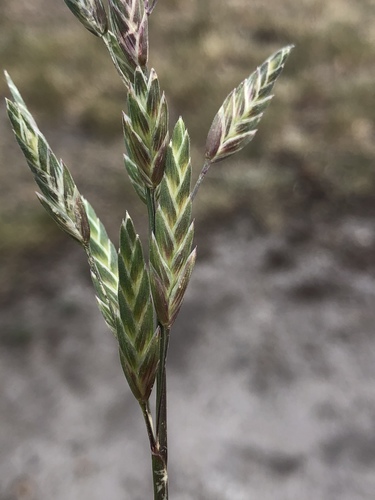
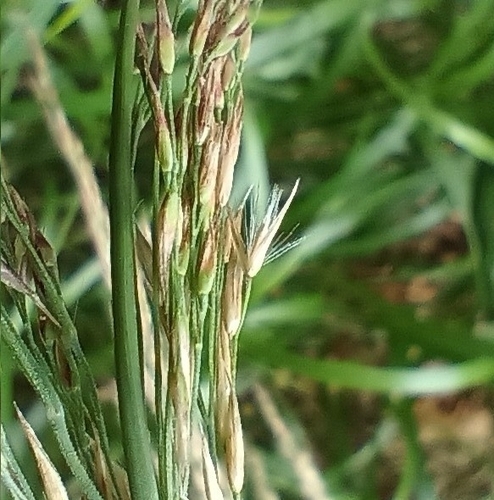
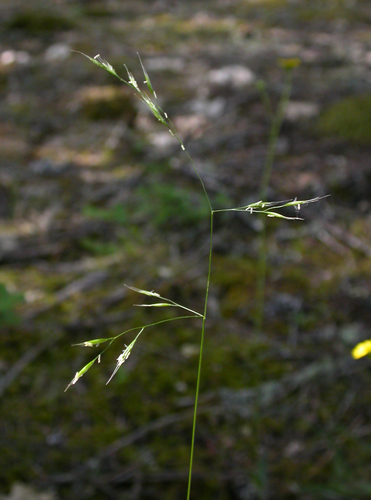
Festuca occidentalis Hook. is a tufted fescue grass that has no rhizomes. Its culms, which are smooth and shiny, grow between 50 and 110 cm (20 to 43 inches) tall. Each culm has two exposed nodes and glabrous internodes, and all shoots are intravaginal. Its leaf sheaths are glabrescent, rounded, and have a prominent midvein, with a distinct swelling marking the position of the auricle. The minutely erose ligule ranges from 0.1 to 0.4 mm (0.0039 to 0.0157 inches) long. Basal leaves are capillary and measure 5 to 30 cm (2.0 to 11.8 inches) long. In cross section, leaf blades are 0.25 to 0.5 mm (0.0098 to 0.0197 inches) wide and 0.3 to 0.65 mm (0.012 to 0.026 inches) thick, with three large veins and one to five ribs. Basal offshoots are erect, growing from the tops of pale brown sheaths. The inflorescence is a lax, subsecund, flexuous panicle that is 10 to 25 cm (3.9 to 9.8 inches) long. At the panicle's lower node, there are two unequal, strongly reflexed branches 1 to 5 cm (0.39 to 1.97 inches) long that bear minute trichomes. Spikelets each hold three to five flowers, and measure 6 to 10 mm (0.24 to 0.39 inches) long. The rachilla is visible at anthesis, with internodes 1 to 1.5 mm (0.039 to 0.059 inches) long. Glumes are unequal, narrow, and acute. The lower glume is 2 to 3.6 mm (0.079 to 0.142 inches) long with one vein, while the upper glume is 3 to 3.4 mm (0.12 to 0.13 inches) long with one to two veins. Lemmas are membranaceous, shaped oblong to lanceolate, 5 to 6.5 mm (0.20 to 0.26 inches) long, and have slender, flexuous awns 2.5 to 7 mm (0.098 to 0.276 inches) long. Paleas have inflexed sides that meet in the middle, and measure 4 to 5.5 mm (0.16 to 0.22 inches) long. Lodicules are toothed and do not have trichomes. Anthers are 1 to 2 mm (0.039 to 0.079 inches) long, and the ovary is pubescent at its apex. This species flowers from late June through July. Festuca occidentalis grows in the northern United States and southern Canada, ranging from the Bruce Peninsula to northern Michigan and eastern Wisconsin, and from Montreal and British Columbia south to Wyoming and California. It inhabits dry to moist woods, thickets, and rocky slopes, and grows at elevations up to 3,100 m (10,200 ft).