About Ferocactus viridescens (Torr. & A.Gray) Britton & Rose
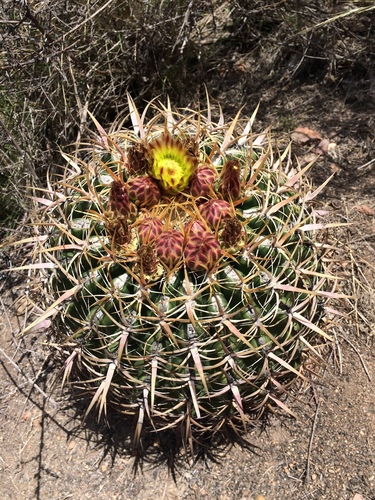
Ferocactus viridescens is a solitary barrel cactus, typically growing in a spherical, oblate, or nearly cylindrical shape. Mature specimens reach 10 to 30 centimeters in height, occasionally up to 45 centimeters, and have diameters of 10 to 20 centimeters, occasionally up to 35 centimeters. Its bright green fleshy body forms 13 to 34 blunt ribs covered in clusters of long spines. The areoles, structures that produce spines, are narrow elliptic to oval, 10 to 20 millimeters long, and covered with brownish fuzz; each areole bears 10 to 19 spines, divided into central and radial types. Central spines are pink or yellowish when young, fading to a duller color with age. The main central spine measures 3 to 5 centimeters long, and 2 to 3 millimeters wide, occasionally up to 5 millimeters wide. The 10 to 20 radial spines resemble the central spines but are smaller, measuring 1 to 2 centimeters long. This species blooms from spring to early summer, producing funnel-shaped flowers that are 2.5 to 5 centimeters long and 3 to 6 centimeters in diameter. Its perianth segments are greenish-yellow or greenish, and sometimes have a pink tinge. Stamens extend almost to the top of the ovary on the flower tube, and the stigma lobes are yellow. Fruits are barrel-shaped, most often bright yellow, and rarely reddish, with a pleasant acidic taste. They measure 20 to 35 millimeters long and 15 to 25 millimeters across, have a leathery outer skin, and bear around 30 fringed-toothed scales. Fruits open through a pore at their base to release seeds. The seeds are elongated and obovoid, finely net-patterned, and 1.6 to 1.8 millimeters long. This cactus is distributed in northwestern Baja California, Mexico, and San Diego County, California, United States. In Baja California, it is a common coastal species found from the vicinity of San Quintín, at the edge of the California Floristic Province, north to the international border near Tijuana. In San Diego County, it occurs mostly in the southwestern coastal portion of the county, and its abundance has declined due to urbanization. Its northernmost range reaches the San Luis Rey River in Oceanside and adjacent parts of Marine Corps Base Camp Pendleton. It grows at elevations from sea level up to 200 meters, and can tolerate both mild-winter coastal microclimates and warmer inland areas that may experience autumn or winter frosts. It prefers sandy and gravelly soils that are generally high in mineral content, but low in organic matter. Habitats where it grows include chaparral, arid hills, dry grassy dunes, rocky coastal bluffs, and sun-baked cliffs. It thrives particularly along the west coasts of California and Baja California, where regular year-round fog cover, also called marine layer, occurs most often in mornings and evenings, letting the cacti absorb enough moisture before daytime heat. This habitat also gives the species a natural tolerance to salts and minerals that most other plant species cannot withstand. It can also be found growing on shrub-covered hillsides, often on slope crests, and in cobble deposits. Occasionally, it grows in large numbers on the edges of vernal pools, a habitat that is moister than its typical dry environment, and this occurrence appears only sporadically in years with above-average precipitation in the region. In cultivation, this plant is hardy to temperatures as low as 5 °C (41 °F). It must be grown under glass in temperate regions, but can be placed outdoors in a sheltered location during warm summer months. It has been awarded the Royal Horticultural Society's Award of Garden Merit.