About Ferocactus latispinus subsp. spiralis (Karw. ex Pfeiff.) N.P.Taylor
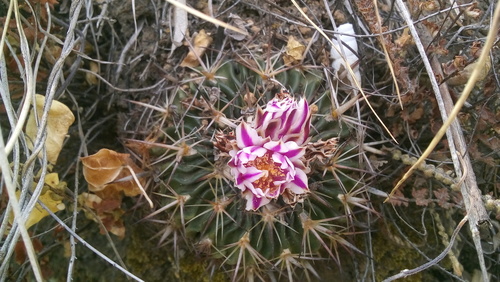
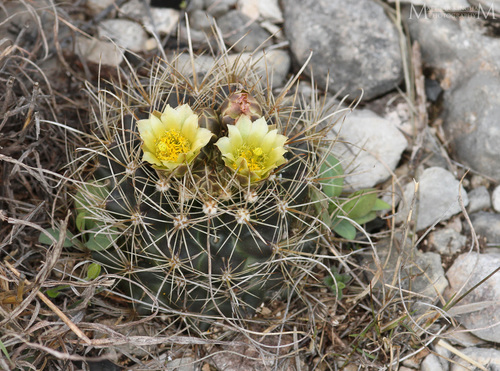
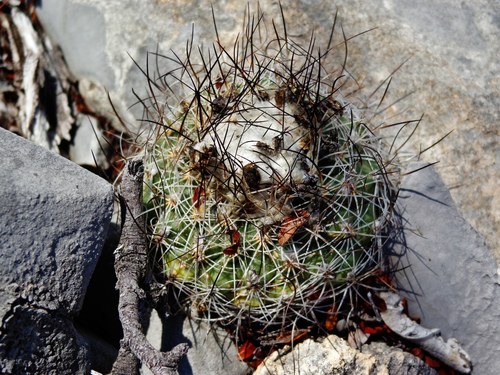
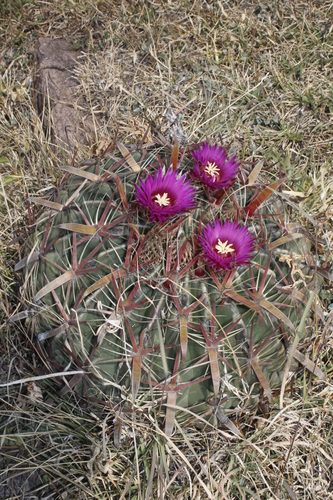
Ferocactus latispinus grows as a solitary, globular light green cactus, reaching heights of 30 cm (12 in) to 1 m, and widths of 40 cm (16 in). It has 21 sharp ribs, with flattened spines that range in color from reddish to white. It produces four central spines that grow up to 4–5 cm (1.6–2.0 in) long and 4–9 mm (0.16–0.35 in) wide, alongside 5–15 straight or recurved marginal spines. Flowering occurs in late autumn or early winter; its funnel-shaped flowers, which are either purplish or yellowish, reach 4 cm in length. Flowers are followed by oval, scaled fruit that grows to 2.5 cm (0.98 in) long. This species is endemic to Mexico. The more widely distributed subspecies latispinus ranges from southeastern Durango, through Zacatecas and Aguascalientes, east to western parts of San Luis Potosí, Hidalgo, and Puebla, as well as into eastern Jalisco, Guanajuato, Querétaro, and Mexico State. Subspecies spiralis is restricted to the southern parts of Oaxaca and Puebla. This species is typically found growing under nurse plants such as tree canopies and shrubs, which protect the smaller cacti below from harsh weather and provide shade in arid, sunny environments. It grows in oak forests, grasslands, silt flats, and rocky outcrops, at elevations ranging from 600 to 2,600 metres (2,000 to 8,500 ft). Ferocactus latispinus is fairly commonly cultivated as an ornamental plant. A desirable horticultural trait is that it blooms at an early age. It is hardy to −4 °C, and prefers an average minimum temperature of 10 °C. The slime mold Didymium wildpretii feeds on the decaying remains of F. latispinus in Mexico.