About Felis chaus Schreber, 1777
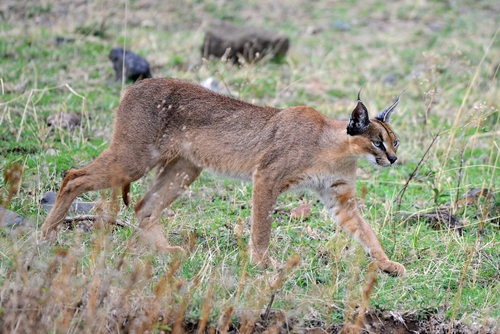
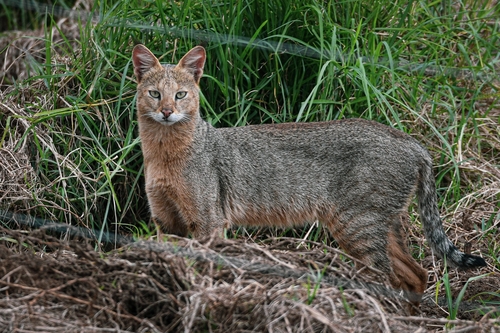
Characteristics: The jungle cat (Felis chaus Schreber, 1777) is a medium-sized, long-legged cat, and the largest of all living Felis species. Its typical head-and-body length ranges from 59 to 76 cm (23 to 30 in), it stands nearly 36 cm (14 in) tall at the shoulder, and it weighs 2–16 kg (4.4–35.3 lb). This species' body size decreases from west to east across its range, a pattern attributed to greater competition from smaller cat species in the east. It also shows a similar size decrease from northern latitudes toward the tropics. Jungle cats are sexually dimorphic: females are generally smaller and lighter than males. They have long, narrow faces with white muzzles. Their large, pointed ears measure 4.5–8 cm (1.8–3.1 in) in length, are reddish brown on the back, and are set close together; a small tuft of black hairs nearly 15 mm (0.59 in) long grows from the tip of each ear. Their eyes have yellow irises and elliptical pupils, with visible white lines around the eyes. Dark lines extend from the inner corners of the eyes down the sides of the nose, and a dark patch marks the nose. The jungle cat's skull is fairly broad at the zygomatic arch, which makes its head appear relatively rounder. Its coat is sandy, reddish brown, or grey, and is uniformly colored with no inherent spots; melanistic and albino individuals have been reported from the Indian subcontinent. White cats observed in coastal areas of the southern Western Ghats did not have the red eyes typical of true albinos, and a 2014 study suggested this coloration could be caused by inbreeding. Kittens are striped and spotted, and some adults may retain these faint markings. Dark-tipped hairs cover the body, giving the cat a faintly speckled appearance. The belly is generally lighter than the rest of the body, and the throat is pale. The fur is denser on the back than on the underparts. Jungle cats have two moults per year; their summer coat is rougher and lighter than their winter coat. The insides of their forelegs have four to five dark rings, and faint markings may be visible on the foreleg outsides. Their black-tipped tail is 21 to 36 cm (8.3 to 14.2 in) long, and has two to three dark rings on the final third of its length. Jungle cat pawprints measure about 5 cm × 6 cm (2.0 in × 2.4 in), and the cat can cover 29 to 32 cm (11 to 13 in) in a single step. It has a distinct spinal crest. Due to its long legs, short tail, and ear tufts, the jungle cat resembles a small lynx, and it is larger and more slender than the domestic cat. Distribution and habitat: The jungle cat is found in the Middle East, the Caucasus, the Indian subcontinent, central and Southeast Asia, Sri Lanka, and southern China. It is a habitat generalist that inhabits areas with adequate water and dense vegetation, including swamps, wetlands, littoral and riparian areas, grasslands, and shrubland. It is common in agricultural lands such as bean and sugarcane fields across its range, and is often sighted near human settlements. Because reeds and tall grasses are typical of its preferred habitat, it is also called the "reed cat" or "swamp cat". It can survive even in areas with sparse vegetation, but does not adapt well to cold climates and is rare in regions with regular snowfall. Historical records place it up to elevations of 2,310 m (7,580 ft) in the Himalayas, and it avoids rainforests and woodlands. Specific regional records include: wetlands near Manavgat, Akyatan Lagoon on the southern coast, and near Lake Eğirdir in Turkey; the Nablus, Ramallah, Jericho, and Jerusalem Governorates of the West Bank (Palestinian territories) in surveys conducted between 2012 and 2016; a wide range of habitat types from plains and agricultural land to mountains at 45 to 4,178 m (148 to 13,707 ft) elevation across at least 23 of 31 provinces in Iran; Haripur District, Dera Ismail Khan District, Sialkot District, and Langh Lake Wildlife Sanctuary in Pakistan; it is the most common small wild cat in India; alpine habitat at 3,000–3,300 m (9,800–10,800 ft) elevation in Nepal's Annapurna Conservation Area, recorded between 2014 and 2016; and a highly fragmented forest in Selangor, Malaysia, recorded in 2010. A small number of jungle cat mummies have been found alongside other cats in ancient Egypt. Ecology and behaviour: The jungle cat is typically diurnal and hunts throughout the day, with reduced activity during hot midday hours. It rests in burrows, grass thickets, and scrubs, and often sunbathes on winter days. Jungle cats are estimated to walk 3–6 km (1.9–3.7 mi) at night, though this distance likely varies based on prey availability. The jungle cat's behaviour has not been extensively studied. It is solitary, and only associates with other members of its species during the mating season. The only consistent social interaction is the bond between a mother and her kittens. Individuals maintain territories via urine spraying and scent marking; some males have been observed rubbing their cheeks on objects to leave scent marks. The main predators of the jungle cat are leopards, tigers, bears, crocodiles, dholes, golden jackals, fishing cats, large raptors, and snakes. The golden jackal is a particularly major competitor of the jungle cat. When encountering a threat, the jungle cat will vocalize before attacking, producing sounds similar to small roars — a behaviour that is uncommon among other members of the genus Felis. The jungle cat's meow is also lower in pitch than that of a typical domestic cat. Jungle cats can host parasites including Haemaphysalis ticks and Heterophyes trematode species. Reproduction: Both male and female jungle cats reach sexual maturity by one year of age. Females experience oestrus periods that last about five days, occurring from January to March. In males, spermatogenesis takes place mainly in February and March. In southern Turkmenistan, mating occurs from January to early February. The mating season is marked by noisy fights between males to establish dominance. Mating behaviour is similar to that of domestic cats: the male pursues the oestrus female, seizes her by the nape of the neck and mounts her. Vocalisations and flehmen response are common during courtship. After successful copulation, the female gives a loud cry and becomes averse to her partner, after which the pair separates. Gestation lasts nearly two months. Births occur between December and June, though this timing varies geographically. Before giving birth, the mother prepares a grass-lined den in an abandoned animal burrow, hollow tree, or reed bed. Litters have one to five kittens, with a typical size of two to three kittens. Females can raise two litters per year. Newborn kittens weigh 43 to 55 g (1.5 to 1.9 oz), and wild-born kittens tend to be much smaller than those born in captivity. Kittens are initially blind and helpless; they open their eyes at 10 to 13 days of age and are fully weaned by around three months. Males do not usually participate in raising kittens, though captive males have been observed to be very protective of their offspring. Kittens begin catching their own prey at around six months and leave their mother after eight or nine months. The lifespan of jungle cats in captivity is 15 to 20 years, which is likely longer than the typical lifespan in the wild. The jungle cat's average generation length is 5.2 years.