About Felicia heterophylla (Cass.) Grau
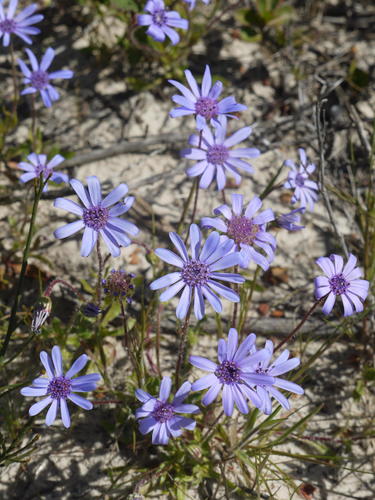
Felicia heterophylla (Cass.) Grau is an annual herbaceous plant that grows up to 35 cm (12 in) tall, and branches heavily especially near its base. Its leaves are arranged oppositely, and are inverted lance-shaped, measuring 1–5 cm (0.4–2.0 in) long and approximately ½ cm (0.2 in) wide. Leaves narrow toward their base into a winged stalk, have smooth edges or a few weak teeth, bear a row of hairs along the margin, and have bristly hairy surfaces. Each leaf has one main vein, with two additional faint side veins. Flower heads are borne individually at the tips of grooved, glandular hairy flower stalks that reach up to 15 cm (6 in) long, and these stalks emerge from leaf axils. The flower heads are heterogamous capitula, containing both female ray florets and a mix of bisexual and male disc florets. At the base of the head, two whorls of sepal-like bracts called phyllaries surround and protect the florets before they open; together these form an involucre around 8 mm (0.32 in) in diameter. The phyllaries are approximately 7 mm (0.28 in) long, with papery margins. The outer whorl of phyllaries is lance-shaped, about 1½ mm (0.06 in) wide, and covered in rough glandular hairs, while the inner phyllaries are narrowly inverted egg-shaped and carry few glandular hairs. Around seven deep blue ray florets surround the central disc; each of these ray florets has a hairy tube that widens at the top into a spreading blade around 15 mm (0.6 in) long and 5 mm (0.2 in) wide. The dry, one-seeded, indehiscent fruits (called cypselae) produced by ray florets have no pappus. The many disc florets are most often blackish blue, rarely brown-red or yellow, are bisexual, and measure about 5 mm (0.20 in) long. As with all species in the Asteraceae family, the five anthers of each disc floret are fused into a hollow tube. When the floret opens, the style grows through this tube, collecting pollen on its shaft. The anthers produce cream-colored pollen, are deep blue themselves, and have a short triangular appendage at their tip. Each cypsela from disc florets carries a whitish pappus made of many bristles around 5 mm (0.20 in) long. The lower quarter of these bristles has short teeth, while the upper sections are feathery, with side branches approximately 0.3 mm (0.012 in) long. The disc floret cypselas are elliptical, about 4½ mm (0.18 in) long and 2 mm (0.08 in) thick, with scaly, thickened ribs along their edges and blunt 0.7 mm (0.028 in) hairs covering their surface. Felicia heterophylla is a diploid organism with a chromosome count of 2n=10 (five sets of homologous chromosomes). This species occurs between Clanwilliam in the north and the Cape Peninsula in the south. This plant, sometimes called the true-blue daisy, is occasionally grown as an ornamental plant.