About Felicia fruticosa (L.) G.Nicholson
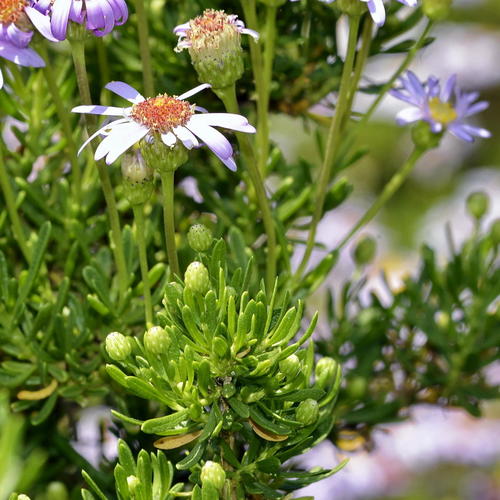
Felicia fruticosa is a strongly branching shrub that can reach up to 1 or 1.3 meters (4 feet 3 inches) in height. Its trunk and side branches have fibrous, peeling, greyish-brown bark, and end in young, non-flowering long shoots. Moderately branching short shoots, each bearing 1 to 3 floral heads, grow in the leaf axils of two-year-old and older long shoots. Its slightly succulent leaves are arranged alternately, and vary in shape and size between subspecies. The typical subspecies has leaves that are lance-shaped to inverted lance-shaped, reaching up to 1.25 centimeters (0.49 inches) long and 2.5 millimeters (0.098 inches) wide, with a pointed tip. Subspecies brevipedunculata always has distinctly inverted lance-shaped leaves, up to 2.5 centimeters (0.98 inches) long and 2 millimeters (0.079 inches) wide. The flat leaf surface is hairless, and faintly marked by round resin glands embedded in the leaf tissue. The broadened leaf base runs slightly down the stem; the leaf margin may be hairless or ciliate, and the leaf axil may have woolly hairs. Floral heads are medium-sized, and their stalks also differ between subspecies. The typical subspecies has floral heads that sit on largely leafless inflorescence stalks up to 2.5 centimeters (0.98 inches) long, while subsp. brevipedunculata has almost stalkless heads that sit directly in the rosette of short shoots. Involucral bracts overlap in up to four rows, forming a structure about 8 millimeters (0.31 inches) in diameter. Bract size increases from the outer to inner rows: the outermost bracts are 1.5 millimeters (0.059 inches) long and 0.5 millimeters (0.020 inches) wide, while the innermost are 4 millimeters (0.16 inches) long and 1 millimeter (0.039 inches) wide. All bracts are lance-shaped with resinous calluses, yellow-brown, and have smooth margins. They are hairless except for the lowest bracts, which are slightly woolly at their inner base. Each floral head holds up to around twenty ray flowers, which are medium or light purple, rarely white. Each ray flower has a ligule (strap) approximately 10 millimeters (0.39 inches) long and 2 millimeters (0.079 inches) wide. The ray flowers encircle numerous yellow disc florets, each with a corolla up to 4 millimeters (0.16 inches) long. In the center of each disc floret, five anthers are fused into a tube, through which the style grows as the floret opens. Both style branches have a narrow triangular appendage at their tip. At the base of each floret, there are many pappus bristles of two distinct lengths: the shorter bristles are white, scaly, persistent, and around 0.1 millimeters (0.0039 inches) long. When mature, the dry, single-seeded, indehiscent fruits called cypselae are dark brown with a lighter margin. They measure 2.5 millimeters (0.098 inches) long and 1 millimeter (0.039 inches) wide, are narrowly obovate in shape, have a scaly epidermis, and are covered in loose, evenly distributed silky hairs. Felicia fruticosa is a diploid with 2n=18, meaning it has nine sets of homologous chromosomes. Regarding distribution, Felicia fruticosa subsp. fruticosa is endemic to the Cape Peninsula and the area surrounding Stellenbosch. Felicia fruticosa subsp. brevipedunculata has been recorded from the Soutpansberg, Blouberg, and the Portugal Farm in Limpopo Province, South Africa, where it grows at elevations between 1,300 and 1,850 meters (4,270 and 6,070 feet).