About Felicia elongata (Thunb.) O.Hoffm. ex Zahlbr.
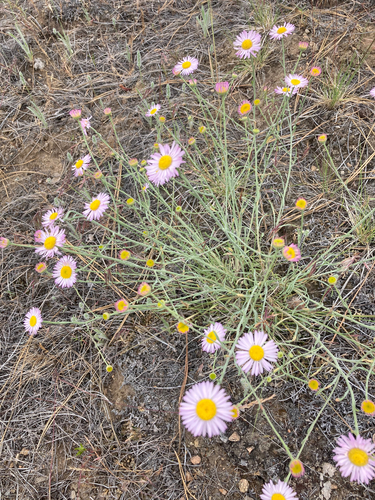
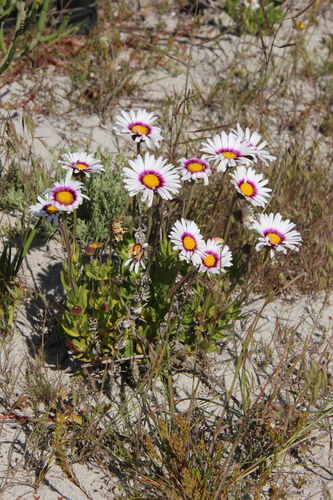
Felicia elongata is an upright perennial herbaceous plant with a woody base that reaches up to approximately 40 cm (1+1⁄3 ft) in height. Its leaves are arranged oppositely along the stem, rigid, oval in outline, 3–4 cm (1+1⁄5–1+3⁄5 in) long and 8–10 mm (0.31–0.39 in) wide. Each leaf typically has one central vein, with two additional veins visible only rarely. The leaf margins curl downwards; the upper leaf surface is densely covered in coarse hairs, while the lower surface is gray-green and may lose some of its hairs over time. Flower heads measure about 5 cm (2 in) across, and grow individually at the top of 15 cm long (rarely up to 20 cm) stalks that are covered in dense velvety hairs. The involucre is almost 2 cm (4⁄5 in) in diameter, made up of two distinct rows of bracts around 8 mm (0.31 in) long, which are roughly fringed at the tip. The outer bracts are narrowly lance-shaped, and 0.8 mm (0.031 in) wide; the inner bracts are lance-shaped, about 1 mm (0.039 in) wide, single-ribbed, and lose their hairs over time. Numerous female ray florets bear a milky white (rarely magenta) strap approximately 17 mm (2⁄3 in) long and 3 1/2 mm wide, with a dark purple zone near the base. Many bisexual disc florets have an orange-yellow corolla about 6 mm (1⁄4 in) long. At the center of each corolla, five anthers are merged into a tube; when the floret opens, the style grows through this tube, collecting pollen onto its shaft. Numerous white pappus bristles around 6 mm (1⁄4 in) long surround the base of each corolla. The dark brown, dry, one-seeded, indehiscent fruits (called cypselae) are elliptical to inverted egg-shaped, about 3 mm (0.12 in) long and 1.2 mm (0.047 in) wide, with a marginal ridge. The fruit surface has some weak scales, and is evenly covered in 0.2 mm (0.0079 in) long hairs. Felicia elongata is a diploid, with eight sets of homologous chromosomes (2n=16). This species, commonly called Saldanha felicia, is only found growing on limestone ridges and coastal sands along Langebaan Lagoon, from the edge of Vredenburg Peninsula north to Paternoster. Flower heads are primarily pollinated by bees. Seedheads develop within one month after the flower heads open. It often grows near other species including the Cape daisy (Dimorphotheca pluvialis), blue flax (Heliophila coronopifolia), and may grow in the shade of rooi malva (Pelargonium fulgidum) or dikbeen malva (P. gibbosum). After flowering and setting seed, above-ground plant parts die back, and the species survives the long hot summer as short, leafless woody stumps. New growth begins as soon as winter rains arrive. It grows in four vegetation types: Langebaan Dune Strandveld, Saldanha Flats Strandveld, Saldanha Granite Strandveld and Saldanha Limestone Strandveld. Felicia elongata is sometimes cultivated as an ornamental plant, and grows quite easily. It thrives particularly well in well-draining garden soil.