About Felicia amoena (Sch.Bip.) Levyns
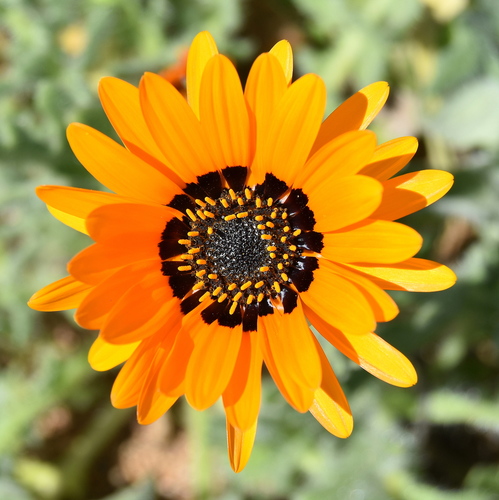
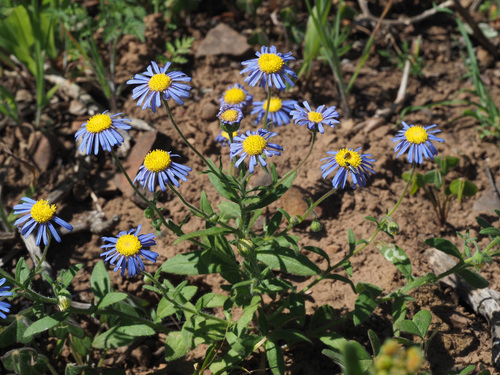
Felicia amoena (Sch.Bip.) Levyns has three recognized subspecies. Felicia amoena subsp. amoena is an upright herb that grows up to 25 cm (10 in) high. It is usually biennial, and may sometimes be perennial; its base is sometimes slightly woody, and it usually branches heavily. Branches are often crowded near the plant’s base, and nodes that rest on the ground easily develop roots, while the farther portions of side branches grow upward. Leaf arrangement on the stem shifts from opposite to alternate. Several opposite leaf pairs grow at the base of the plant, and leaves become alternate further up the stem. After each branching event, the lower one or two leaf pairs are opposite again. Leaf size varies greatly based on growing conditions, and leaves can reach up to 4 cm (1+3⁄5 in) long and 2 1⁄2 mm (0.1 in) wide. Leaves are linear to lance-shaped, covered in bristly hairs, sometimes becoming hairless with age, thick, and have downward-curled margins. Flower heads grow individually on stalks up to 12 cm (4+1⁄2 in) long that are densely felty hairy near the top, and most often emerge in groups of three at branch tips. The involucre reaches up to 7 mm (0.28 in) in diameter and consists of a double row of bracts. Involucral bracts are linear to lance-shaped, about 5 mm (1⁄5 in) long, and have a brush-like tuft of hairs at their tips. Outer bracts are 0.5 mm (0.020 in) wide and bear arched bristles. Inner bracts are 0.6 mm (0.024 in) wide, slightly bristly, and have a prominent midrib. Flower heads hold up to twenty-five dark blue female ray florets, with straps approximately 12 mm (0.47 in) long and 2 mm (0.079 in) wide. These surround many bisexual disc florets with a yellow corolla up to 3 mm (0.12 in) long. Five anthers are merged into a tube at the center of each corolla. When the floret opens, the style grows through this tube, collecting pollen onto its shaft. A triangular appendage sits at the tip of both style branches. Many white, serrated pappus bristles about 3 mm (0.12 in) long surround the base of the corolla. The mature one-seeded, dry, indehiscent fruits called cypselae are dark brown and inverted egg-shaped. They measure about 2.5 mm (0.098 in) long and 1.2 mm (0.047 in) wide, have a prominent ridge along the margin, and bear some scales and short, forked hairs on their surface. Felicia amoena subsp. latifolia is a diploid with eight sets of homologous chromosomes (2n=16). Regarding distribution, habitat, and ecology: Felicia amoena subsp. amoena has the smallest range of the three subspecies, and is restricted to sandy soils around the Cape Peninsula and near Gordons Bay. Subsp. latifolia has the largest range, occurring along the coast from the Cape Peninsula in the far west to the mouth of the Sundays River in the east, with an isolated population also found in the southern Cedarberg. Subsp. stricta grows inland, ranging from the Cedarberg in the north, along the western edge via Piketberg, around Ceres, near Worcester and Swellendam on the eastern edge, to Bredasdorp in the south.