About Felicia amelloides (DC.) Voss
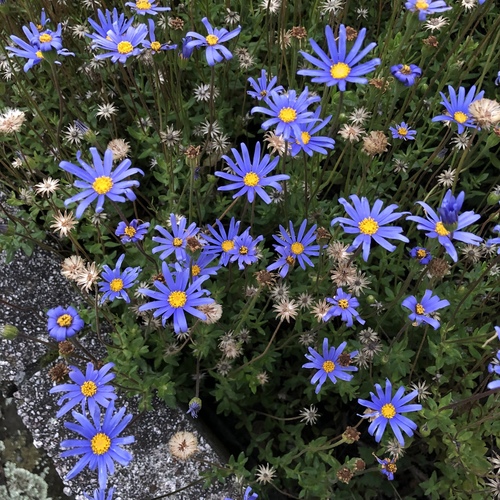
Felicia amelloides is an evergreen, herbaceous plant that is usually a densely and regularly branched upright perennial, sometimes a biennial, with a woody base. It grows to about 50 cm (1.6 ft) tall, and sometimes reaches up to 1 m in height. All of its leaves are arranged oppositely along the stem. They are typically 2–5½ cm (¾–2 in) long and 1–2½ cm (0.4–1.0 in) wide, though their size varies strongly. Leaves are elliptic to inverted egg-shaped, with a blunt or vaguely pointed tip and an entire margin. Leaves near the base of the plant may have a short stalk. Leaves are stiff and leathery, with a sandpapery texture from a covering of short bristle-like hairs. Each leaf has one to three conspicuous veins, and leaf margins curl downwards. The upper leaf surface is dark green, while the underside is a lighter color. This species, commonly called blue daisy, occurs in a coastal strip along the south coast of South Africa’s Western Cape and Eastern Cape provinces, ranging from De Hoop Nature Reserve in the west to the mouth of the Kei River in the east. In the Eastern Cape, it extends furthest inland at Vanstadensberg near Port Elizabeth, the Groot Winterhoek Mountains near Uitenhage, and Ecca Pass on the road between Grahamstown and Fort Beaufort. It is particularly common between Humansdorp and Port Alfred. It does not grow on the Cape Peninsula, where it has often been confused with Felicia aethiopica, which has similar flower heads but alternately arranged leaves above its base. Blue daisy is most common on old stabilizing sand dunes and in sheltered locations, but it also grows on sandy flats, gravelly slopes, stony hillsides, rock slabs, and Table Mountain Sandstone outcrops, at altitudes between 0 and 1,000 m (0–3,281 ft). Felicia amelloides is grown as an ornamental plant in both South Africa and other regions around the world. It was introduced to Europe in the eighteenth century, and was one of the first species of this genus adopted into horticulture. It can tolerate light frost if planted in well-draining soil, but does not grow well in moist heat. In hot climates, it stops flowering during the summer months. In colder climates, it is often grown as an annual, kept sheltered in greenhouses, or cultivated as a house plant.