About Faurea saligna Harv.
Species Classification
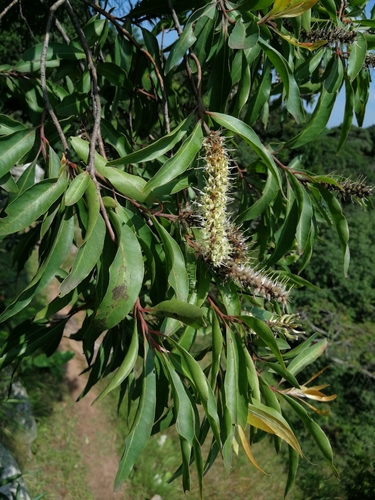
Faurea saligna Harv. is a graceful, semi-deciduous tree that belongs to the Proteaceae family.
Size
It typically reaches around 10 metres (33 ft) in height, and can grow up to 20 metres (66 ft) when growing in forest conditions.
Distribution Range
This tree is found ranging from tropical Africa south to Transvaal, Swaziland, and Natal.
Habitat
It often grows in large groups on sandy soil and alongside stream beds.
Bark and Leaf Characteristics
Its bark is dark-grey to black, rough, and deeply fissured, while its narrow, drooping leaves resemble willow leaves — the specific epithet saligna means Salix-like.
Timber Uses
The timber of this tree was highly valued by the Voortrekkers for making furniture, and they named it Transvaal Boekenhout because the timber resembles that of the European Beech.
Genus Diversity
There are approximately 15 species in the genus Faurea, which are distributed across Africa and Madagascar.
Genus Etymology
William Henry Harvey named the genus in honor of William Caldwell Faure (1822–1844), a young soldier and enthusiastic botanist who was killed in India.
Faure Family Background
Faure was the son of Abraham Faure, a Dutch Reformed minister from Cape Town.
Faure's Early Botanical Activities
He had accompanied Harvey on many botanising excursions, and left the Cape for India in 1844 after receiving a military commission with the East India Company.
Faure's Early Time in India
He contracted cholera shortly after arriving, but luckily recovered.
Faure's Fatal Incident
A few months later, while crossing a forested ravine in the company of several fellow soldiers on his way to rejoin his regiment, he was shot by a sniper.
He died around twelve hours after the shooting.