About Faunis eumeus Drury, 1770
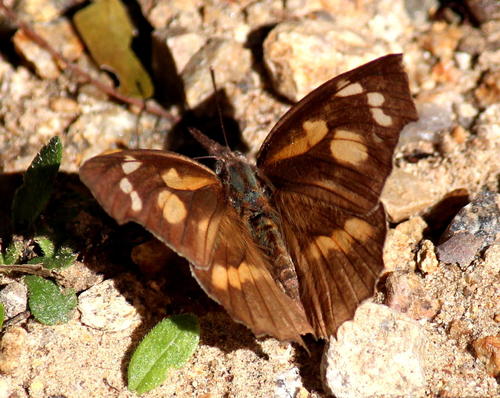
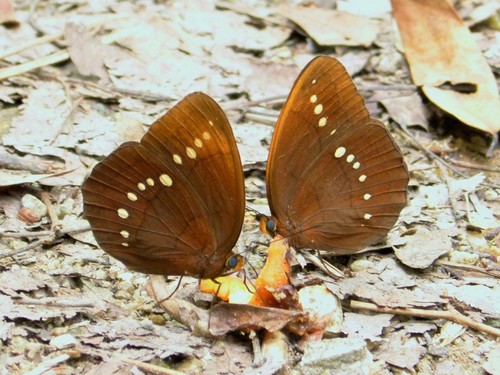
Faunis eumeus Drury, 1770, commonly called the large faun. Description: On the upperside of both males and females, the forewing is maroon, with a very broad, oblique, preapical, somewhat diffuse bright ochraceous band. This band runs from the costa to the termen, and extends along the termen almost to the tornus; it is broader in females than in males. The hindwing is brown, darkening into dark maroon towards its anterior portion. The underside is maroon brown; the apex of the forewing is broadly paler, and the dorsal margin of the forewing is dull brown. Dark, sinuous, continuous lines in the subbasal, discal, and postdiscal regions cross both wings. Between the discal and postdiscal lines lies a series of prominent round white spots: there are five or six spots on the forewing, which are straight in males and slightly incurved in females, and six or seven spots on the hindwing, which are arched in both sexes. The antennae, head, thorax, and abdomen are all brown. Distribution: This species ranges across the area from Assam to the Shan States and Burma.