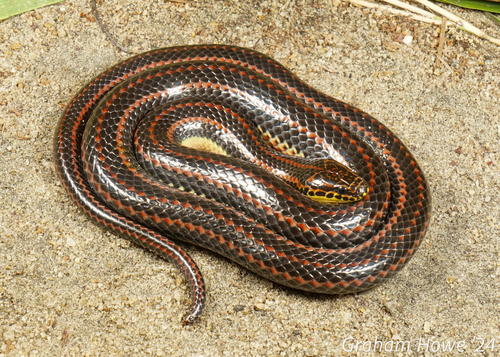
About Farancia erytrogramma (Palissot De Beauvois, 1802)
This species, Farancia erytrogramma, commonly called the rainbow snake, has the following physical description. On its dorsal side, rainbow snakes have smooth, glossy bluish-black back scales marked with three red stripes. They have short tails ending in a spiny tip, which they sometimes use as a probe. Adult individuals may display yellow coloration along their sides and on their heads. Rainbow snakes typically reach a total length including tail of 36 to 48 inches, which equals 91 to 122 centimeters; some specimens have been recorded reaching a maximum total length of 66 inches, or 168 centimeters. Females of this species grow larger than males. Rainbow snakes occupy aquatic habitats, which include cypress swamps, marshes, blackwater creeks, slow-moving streams, and the sandy coastal plain. The geographic range of Farancia erytrogramma extends from southern Maryland to southeastern Louisiana, and covers eastern Virginia, southeastern North Carolina, South Carolina, Georgia, northern Florida, Alabama, and Mississippi. A small population once lived in the Lake Okeechobee region of southern Florida, but this population was declared extinct on October 5, 2011. One individual rainbow snake was observed in Ocala National Forest, Marion County, Florida, in early 2020; this sighting was confirmed by the National Museum of Florida as the first confirmed rainbow snake sighting at this site in 50 years. For reproduction, adult female rainbow snakes typically lay their eggs in July, and bury the clutches underground in sandy soil. An average clutch contains around 20 eggs, though large females can lay more than 50 eggs. The hatchlings emerge in late summer or fall.