About Farancia abacura (Holbrook, 1836)
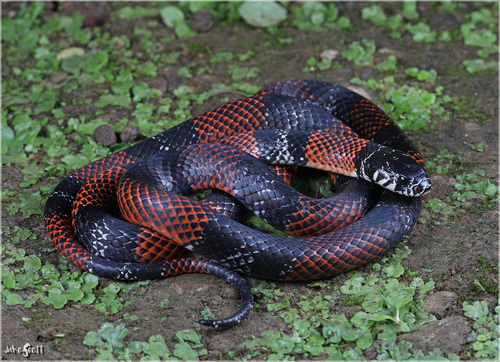
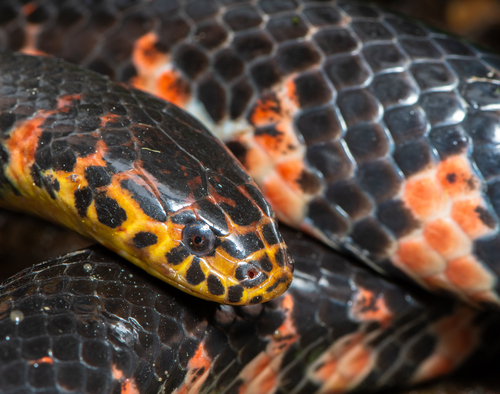
Farancia abacura, commonly called the mud snake, usually reaches a total length including the tail of 40 to 54 inches (1 to 1.4 meters), with a maximum recorded total length slightly over 80 inches (2 meters). This species shows sexual size dimorphism: adult females are longer than adult males. The mud snake’s upper body is glossy black. Its underside is patterned with red and black, with the red color extending up the sides to form reddish-pink bars. Some individuals have an entirely black body with slightly lighter black spots instead of the more common reddish markings. Its heavy body is cylindrical in cross section, and its short tail ends in a terminal spine. It has distinctive head scalation: there is only one internasal scale, no preocular scale, and one anterior temporal scale. Its dorsal scales are smooth, arranged in 19 rows at midbody. It has 168–208 ventral scales, 31–55 subcaudal scales, and a divided anal plate. Farancia abacura is the only species in the genus Farancia, and it contains two distinct subspecies. The mud snake is native to the southeastern United States, where it occurs in the states of Alabama, Arkansas, Florida, Georgia, Illinois, Kentucky, Louisiana, Mississippi, Missouri, North Carolina, Oklahoma, South Carolina, Tennessee, Texas, and Virginia. Farancia abacura inhabits stream edges and cypress swamps, found among dense vegetation or under ground debris. It uses wet conditions to burrow into mud. It is almost entirely aquatic and rarely leaves the water, only doing so to lay eggs, hibernate, or escape drying wetlands during drought. After heavy rainfall, its home range may expand to access new food sources. It lives in both freshwater and brackish aquatic habitats. For hibernation, it most often uses soil cavities or cavities in old tree stumps. Breeding for F. abacura occurs in spring, mainly during April and May. During copulation, the female wraps around the male, and the pair can remain in this position for more than one day. Eight weeks after mating, the female lays a clutch of 4 to 111 eggs in a nest dug into moist soil, sometimes in alligator nests. Mud snake nests are most often found underground under debris, but can occur in other locations. Nests are cavities in sandy soil that hold the laid eggs, and some eggs may even become embedded into the nest cavity walls. There is a positive correlation between female body length and clutch size: larger females produce larger clutches. The female stays with her eggs until they hatch in fall, most often in September or October. Unhatched eggs have never been found in winter or spring, though many juvenile mud snakes are captured entering wetlands in spring, most likely from clutches laid and hatched the previous late summer or autumn. It is thought that mud snake hatchlings either enter aquatic habitats in autumn or delay entering until spring, but it is not known whether hatchlings remain in the terrestrial nest or disperse through terrestrial habitats during this waiting period.