About Fallugia paradoxa (D.Don ex Tilloch & Taylor) Endl. ex Torr.
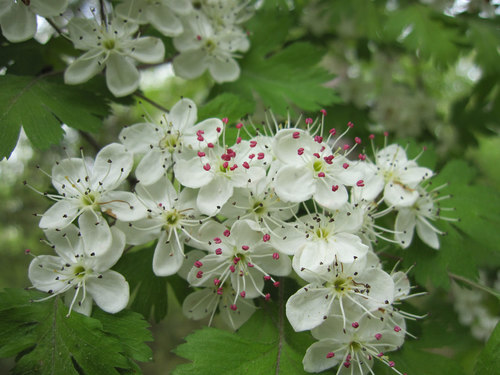
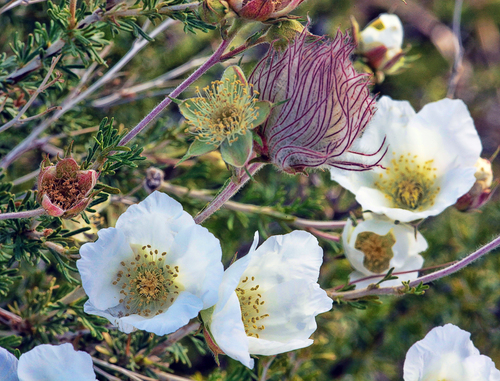
Fallugia paradoxa is an erect shrub that grows no taller than two meters. It produces many thin branches covered in light gray or whitish peeling bark. Its individual leaves are roughly one centimeter long, deeply lobed, and have rolled-under edges. The upper surface of each leaf is green and hairy, while the underside is duller in color and scaly. New flowers of this plant have a rose-like shape, with rounded white petals and a center filled with numerous thin, thread-like stamens and pistils. After the white petals drop off, the flower's ovary remains, leaving behind many plumelike lavender styles that each measure 3 to 5 centimeters long. After flowering, the plant may become covered in these dark pinkish clusters of curling, feathery styles. Each style attaches to a developing small achene fruit. Wind catches the styles to carry the fruit away for dispersal. Wasps such as Polistes instabilis commonly feed on the nectar of Fallugia paradoxa. This species is considered valuable for controlling erosion in the desert areas where it naturally grows. It is also used in xeric landscaping as an ornamental shrub that provides ecological habitat value. It offers visual interest from late spring, when it produces white flowers. These flowers are replaced by pink plumes, which gradually fade to white but keep the plant's feathery appearance throughout the rest of the growing season.