About Fallopia convolvulus (L.) Á.Löve
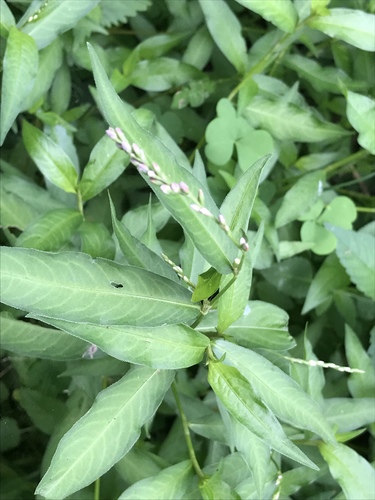
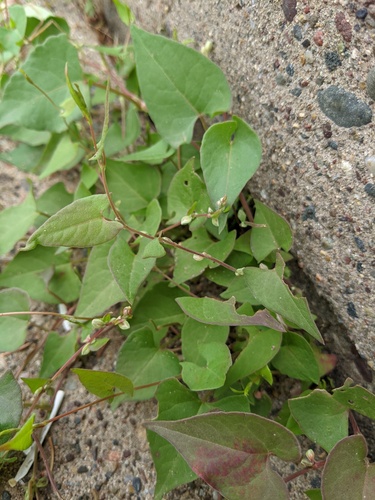
Black-bindweed (Fallopia convolvulus (L.) Á.Löve) is a herbaceous vine that grows 1 to 1.5 meters (39 to 59 inches) long, with stems that twine clockwise around the stems of other plants. Its alternate triangular leaves measure 1.5–6 cm long and 0.7–3 cm broad, and attach to stems with petioles 6–15 mm long (and sometimes up to 50 mm long). The basal lobes of the leaves are pointed at the petiole attachment. This species produces small greenish-pink to greenish white flowers clustered on short racemes. Each flower has 5 sepals, with the 3 outer sepals being larger and marked with a keel, plus 5 stamens. After flowering, the clusters develop into small triangular achenes, each holding one seed; the mature fruit reaches 4 mm in length. While this plant is called black-bindweed and superficially resembles true bindweeds of the genus Convolvulus, it has several clear differences: Black-bindweed has an ocrea (a stipule sheath at the stem nodes), which Convolvulus does not have, and Convolvulus produces large, conspicuous trumpet-shaped flowers, while black-bindweed has unobtrusive flowers that are only around 4 mm long. Fallopia convolvulus grows most frequently on disturbed or cultivated land. In northern Europe, it typically grows on warm, sunny, well-drained sandy or limestone soils. In hotter, drier regions like Pakistan, it grows instead on moist shady sites. Across its range, it occurs from sea level at the northern edge of its distribution, up to 3600 m altitude in the southern Himalayas. The seeds of black-bindweed are edible, and were used as a food source by humans in the past; archaeological remains of the seeds have been found in Bronze Age middens. The seeds are too small and produced in too low of a yield to be a viable commercial crop, so the species is now most widely considered a weed. It grows in crops, waste areas, and along roadsides. It can be a damaging weed in gardens and agricultural crops: it harms the plants it twines around, and can also clog harvesting machinery. It is also classified as an invasive species in North America.