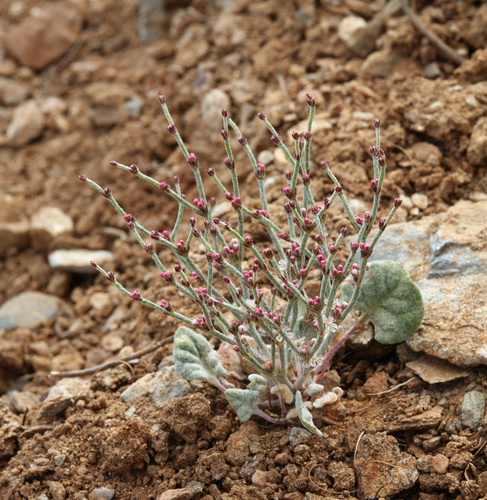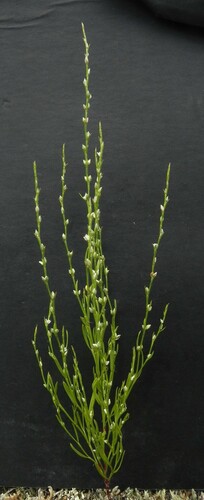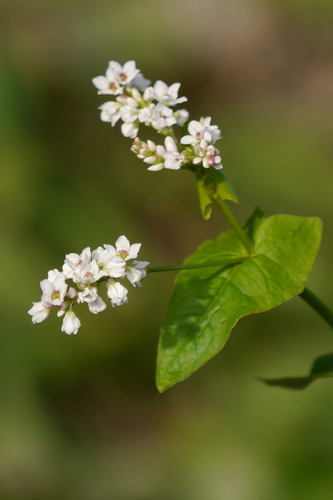
About Fagopyrum esculentum Moench
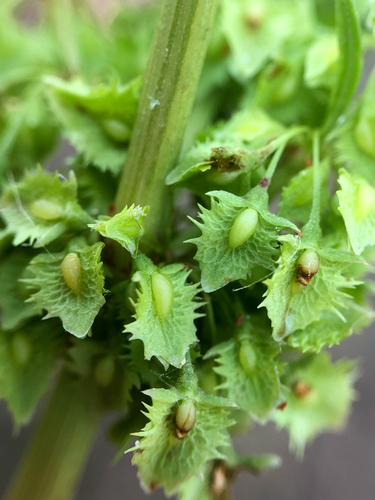
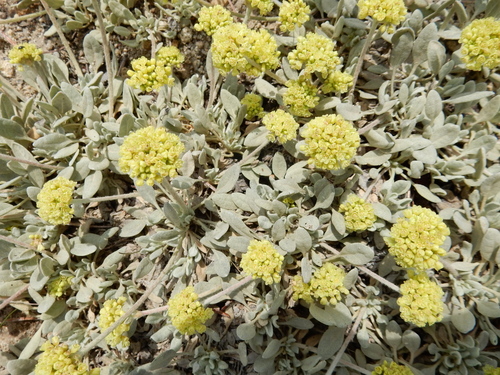
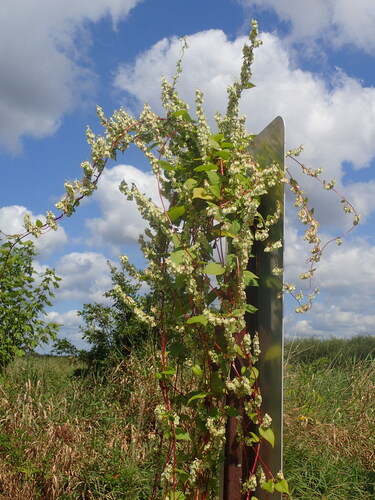
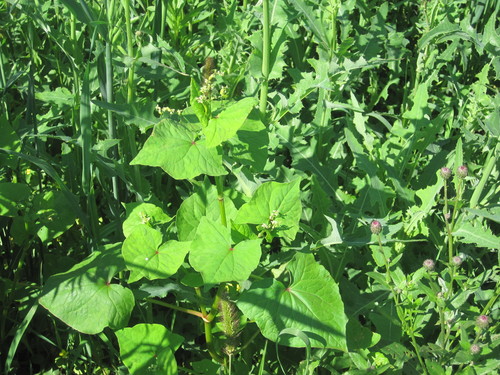
Fagopyrum esculentum Moench, commonly known as buckwheat, is an herbaceous annual flowering plant. It typically grows to around 60 cm (24 in), with red stems, arrow-shaped leaves, and pink-and-white flowers that resemble those of knotweeds. Its fruit is a 5–7 mm achene with 3 prominent sharp angles. Additional cultivation notes describe buckwheat as growing 75 to 125 cm (30 to 50 inches) tall, with a branching root system anchored by a deep primary taproot that reaches into moist soil. It branches freely, rather than producing tillers or suckers, which gives it better environmental adaptation than many other cereal crops. Flowers are usually white, but may also be pink or yellow; seeds are described as tetrahedral.
This species is native to south-central China and Tibet, and has been introduced to suitable climates across Eurasia, Africa, and the Americas.
Buckwheat cultivation is suited to short growing seasons, and grows well in low-fertility or acidic, well-drained soils. Excess fertilizer, particularly nitrogen, reduces yields. In hot climates, it must be sown late to bloom during cooler weather. Yields increase greatly when pollinators are present. Nectar from flowering buckwheat produces dark-colored honey. Buckwheat is grown for grain in locations with only a brief growth window, either as an early or second seasonal crop, or in regions with a limited total growing season. It establishes quickly to suppress summer weeds, and can act as a reliable summer cover crop that fits into a short warm-season slot. Its total growing period is only 10–12 weeks, so it can be grown in high latitude or northern areas. It is sometimes used as green manure, an erosion control plant, or as wildlife cover and feed.
Cases of severe allergic reactions to buckwheat and buckwheat-containing products have been reported. Buckwheat contains fluorescent, phototoxic compounds called fagopyrins. Seeds, flour, and teas are generally safe when consumed in normal amounts, but a condition called fagopyrism can develop in people who eat diets high in buckwheat sprouts, especially buckwheat flowers or fagopyrin-rich buckwheat extracts. Human symptoms of fagopyrism may include skin inflammation on sun-exposed areas, cold sensitivity, and tingling or numbness in the hands.
The edible fruit of buckwheat is an achene similar to a sunflower seed, holding a single seed inside a hard outer hull. The starchy, white endosperm makes up most or all of buckwheat flour. The green or tan seed coat darkens the flour, and dark brown or black hull fragments may appear as dark specks in finished flour. In French, dark buckwheat flour is called blé noir (black wheat), and is also known as sarrasin (saracen); in Italian it is called grano saraceno (saracen grain). Buckwheat grain can be processed by simple dehulling, milling into farina, whole-grain flour, or white flour, and can be separated into starch, germ, and hull for specialized uses.
Buckwheat groats are commonly used in western Asia and eastern Europe, where buckwheat porridge made from roasted groats cooked in broth to a texture similar to rice or bulgur is common and often considered a definitive peasant dish. Jewish, Ukrainian, Russian, and Polish immigrants brought this dish, called kasha, to North America, where it is mixed with pasta or used as a filling for cabbage rolls, knishes, and blintzes. Buckwheat noodles have been eaten for centuries in Tibet and northern China, regions where the growing season is too short to grow wheat. To make these noodles, a wooden press pushes dough directly into boiling water; historical presses found in Tibet and Shanxi share the same basic design. Japanese and Korean noodle-making traditions likely originated from this earlier Chinese and Tibetan process. Buckwheat noodles are a core part of Japanese cuisine as soba, and Korean cuisine as naengmyeon, makguksu, and memil-guksu. Soba noodles carry deep cultural importance in Japan, and the challenge of making noodles from gluten-free buckwheat flour has developed into a traditional hand-making art. Korean cuisine also includes a buckwheat starch jelly called memilmuk; the local Bongpyeong buckwheat variety is a well-known cultural and gastronomic symbol. Buckwheat pasta also appears in Italian cuisine, as pasta di grano saraceno in the Apulia region of Southern Italy, and pizzoccheri in the Valtellina region of Northern Italy.
Buckwheat pancakes are eaten across multiple countries: they are known as buckwheat blini in Russia, galettes bretonnes in France, ployes in Acadia, poffertjes in the Netherlands, boûketes in the Wallonia region of Belgium, kuttu ki puri in India, and kachhyamba in Nepal. Similar buckwheat pancakes were common food for early American pioneers, and are light and airy when baked, with an earthy, mildly mushroom-like flavor. Ukraine makes yeasted buckwheat patties called hrechanyky; in southeastern Poland across the border, the similar name hreczanyki (also hreczki) refers to thick patties of ground pork mixed with cooked buckwheat groats, typically served with mushroom sauce.
Buckwheat is an approved food for fasting in multiple religious traditions. In northern India, people eat buckwheat flour foods during Hindu fasting days such as Navaratri, Ekadashi, Janmashtami, and Maha Shivaratri, when eating common cereals like wheat or rice is prohibited. While strict Hindus may fast from all food and water, many who fast give up cereals and salt and eat non-cereal foods including buckwheat, called kuttu. In the Russian Orthodox tradition, buckwheat is eaten during the St. Philip fast. Buckwheat honey is dark, strong, and aromatic, and is normally produced as a monofloral honey because it does not complement other honey varieties.