About Fadogia homblei De Wild.
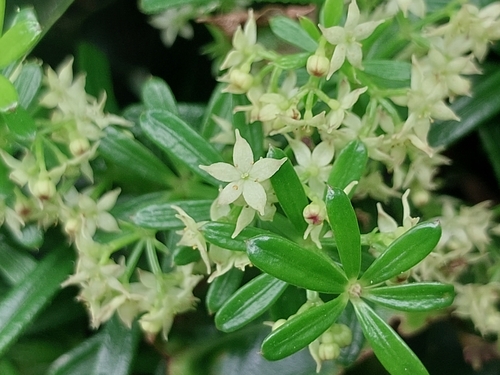
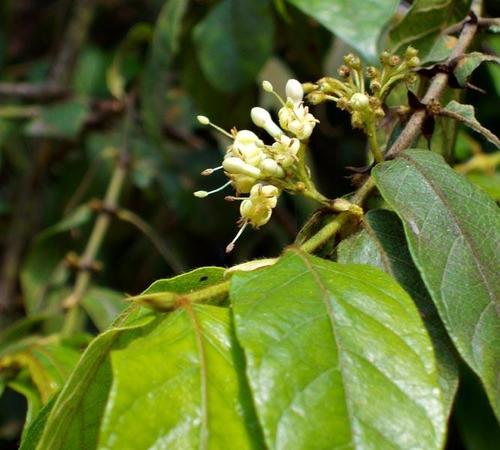
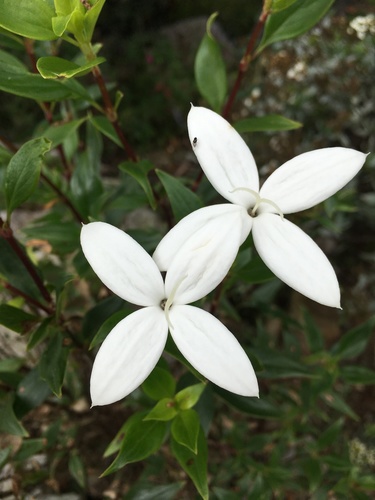
Fadogia homblei De Wild. is an erect perennial sub-Saharan shrublet that grows to 60 cm tall. It has subterranean stems that produce unbranched annual shoots, and it is one of approximately 47 species in the genus Fadogia, which belongs to the Rubiaceae plant family. This species is found in Angola, Tanzania, Malawi, Mozambique, Zambia, Zimbabwe, as well as in Limpopo and Gauteng Provinces of South Africa. Fadogia homblei produces leaves arranged in whorls of 3 to 5. The leaves are elliptic or lanceolate in shape, with a shiny upper surface and greyish-white papillose hairs on the underside. Its fragrant flowers grow in 3-5-flowered whorls that emerge from leaf nodes, and range in color from creamy yellow to bright yellow. The fruit is spherical and crowned with a persistent calyx limb; it is initially green, turns black when ripe, and is edible. Browsing on this species has long been known to cause gousiekte (meaning "quick disease"), a cardiotoxicosis of ruminants marked by heart failure that develops four to eight weeks after ingestion of certain species in the Vangueria, Pavetta, and Fadogia genera. This toxic condition is thought to be caused by the polyamine pavettamine, and all six plant species known to cause gousiekte are members of the Rubiaceae family. Laboratory analysis has found that the concentration of pavettamine in Fadogia homblei is highest in the topmost leaf pair, and decreases toward the base of the plant. All gousiekte-causing plants host symbiotic bacteria in their leaves, which were initially suspected to play a role in producing pavettamine. However, cultures of these bacteria did not contain any traces of pavettamine, which indicates that the toxin is produced either through an interaction between the bacteria and the plant, or solely by the plant itself. The structure of pavettamine was not identified for many years after its first isolation, but was finally published in 2010 by Bode et al., 15 years after the compound was first isolated. The identified structure of pavettamine is (2S,4R,8R,10S)-1,11-diamino-6-aza-undecane-2,4,8,10-tetraol. Despite successful determination of pavettamine's structure, it has not yet been confirmed to be the cause of gousiekte. A large number of compounds have been isolated from the fruits, leaves, and stems of Fadogia homblei, including: Scopoletin, which has documented anti-fungal, anti-spasmodic, anti-oxidant, anti-inflammatory, and anti-cancer properties; Luteolin, which is anti-mutagenic, anti-tumor, anti-oxidant, and anti-inflammatory; Quercetin 3-O-β-D-galactoside, a compound common in plants and an active ingredient in many herbal remedies, with anti-hypertensive and vasodilatory effects; Lupeol, which is anti-oxidant, anti-angiogenic, anti-neoplastic, anti-inflammatory, and anti-malarial; Betulinic acid, which is anti-inflammatory, and has demonstrated in vitro anti-malarial, anti-HIV, and anti-cancer activity; Sitosterol and stigmasterol, common compounds found in nearly all plant species; Pinoresinol, an inhibitor of 15-lipoxygenase; and uracil, isolated from the leaves of Fadogia homblei, which marks the first time uracil has been found in a plant outside of ferns.