About Fabriciana niobe (Linnaeus, 1761)
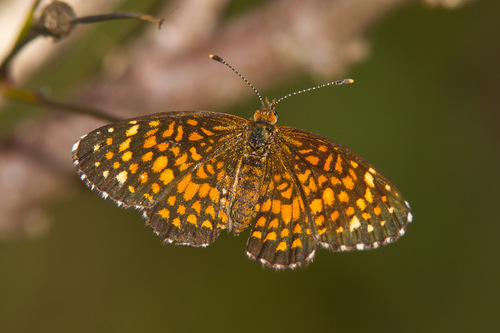
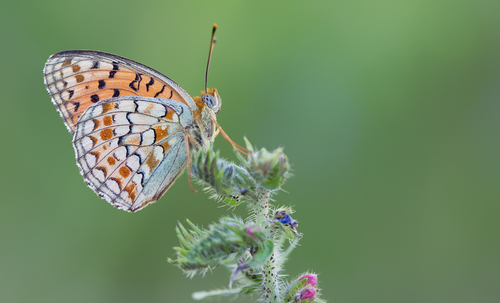
Fabriciana niobe (Linnaeus, 1761) is a medium-sized butterfly species with a wingspan ranging from 46 to 60 millimetres (1.8 to 2.4 inches). Females are noticeably larger than males, and have more prominently marked wings. The upper side of the wings has a bright brown-orange base color patterned with black dots, black crossbands, and a row of submarginal triangular patches. The outer margin of the forewings has a rounded shape. On the underside of the hindwings, there are typically small whitish-silvery spots, a yellow spot that contains a black pupil, black-lined submarginal lunules, and black veins in the basal area. Caterpillars of this species have a dark base color, with small white spots and white thorns. Fabriciana niobe is closely similar in appearance to the dark-green fritillary (Speyeria aglaja) and the high brown fritillary (Fabriciana adippe), but it is smaller than both species. It also has smaller brown spots with silver centers, and its postdiscal silver markings are not continuous. In Seitz's description labeled A. niobe L. (69c), the species is noted to be very similar to Speyeria aglaja above the wings, but can be immediately recognized by its much more variegated underside. The basal half of the hindwing underside lacks uniform verdigris shading; instead, this area bears distinct leathery-yellow patches, which are often centered, edged, or shaded with brownish green. The nymotypical form of Fabriciana niobe has abundant silver spots on the wing underside, more than Speyeria aglaja: the distal band has no silver markings in Speyeria aglaja, while it bears silvery centers in Fabriciana niobe. Fabriciana niobe is common across most of Europe, though it is not found in the United Kingdom or Northern Europe. Its distribution also extends to Siberia, Russia, Iran, China, and Korea. These butterflies inhabit open grassy areas, slopes, woodlands, and clearings, at elevations ranging from sea level up to 2,400 metres (7,900 feet).