About Fabriciana adippe (Denis & Schiffermüller), 1775
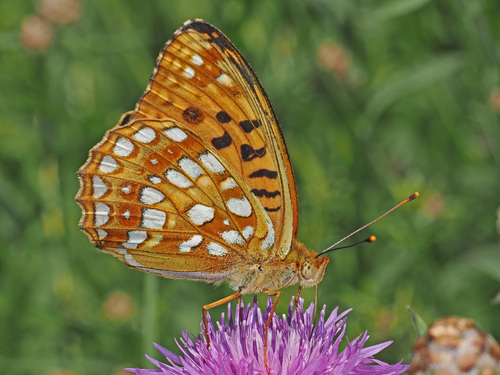
This species, commonly known as the high brown fritillary, has an average wingspan of around 65 mm. Its upper wings are orange with black markings, while the undersides are a duller orange with white and brown markings. In flight, it is very difficult to distinguish from the dark green fritillary, which shares many of the same markings. Males and females share most of the same physical features. The larvae are brown with a single longitudinal white stripe running the full length of their body. Their bodies are covered in brown spikes, which help camouflage them from predators as they move among dead fern fronds. A description from Seitz notes that it (recorded as A. adippe L. (= berecynthia Poda, cydippe L.)) is usually larger than the related species Argynnis alexandra Ménetries, 1832, with more obtuse wings. In females, the outer margin of the forewing is quite straight, and the outer margin of the hindwing is weakly undulate. Males are easily recognized by thickened hairy streaks located on the branches of the median vein on the forewing. On the underside of the wings, the silver spots are much larger than those of the species niobe, especially the marginal spots, which are much longer and broader. This butterfly has many subspecies distributed across temperate regions of Europe, Asia, and Africa. Northern Europe has experienced a severe decline in high brown fritillary populations, but the species remains relatively abundant in other parts of Europe. As of 2015, the high brown fritillary was the most threatened butterfly species in Britain. Persistent populations are only found in four areas of Great Britain: the Morecambe Bay Limestone hills, the Glamorgan Brackenlands, Dartmoor, and Exmoor, and it has declined across most other parts of Northern Europe. There are two main habitats that support high brown fritillary populations: bracken areas and limestone outcrops. Bracken habitats occur across the species' entire geographic range, while limestone outcrop habitats are specific to Great Britain. High brown fritillaries that occupy woodland habitats have been most severely impacted by habitat loss. These butterflies relied heavily on coppicing, a land management technique that has nearly disappeared from the countryside of Great Britain. The reduction of coppicing, combined with replanting and new forest growth, has greatly limited the areas where fritillaries can thrive, as bracken habitats become increasingly rare. Within existing bracken habitats, population loss is driven by either excessively dense bracken growth or trampling of the butterfly's associated flora by grazing animals.