About Exomis microphylla (Thunb.) Aellen
Growth Form and Branching
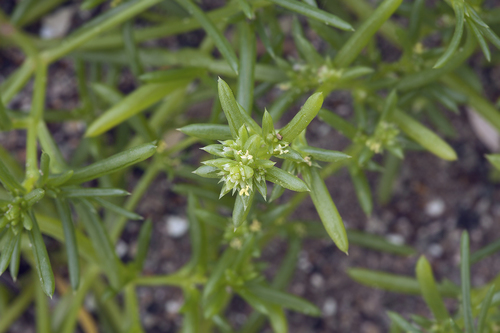
Exomis microphylla (Thunb.) Aellen is a shrub with dichotomous branching, meaning it forks into two equal branches.
Sexual System
This species is monoecious, meaning it produces separate male and female flowers on the same individual plant, and also bears a small number of bisexual flowers that contain both male and female reproductive structures.
Male Flower Inflorescence and Perianth
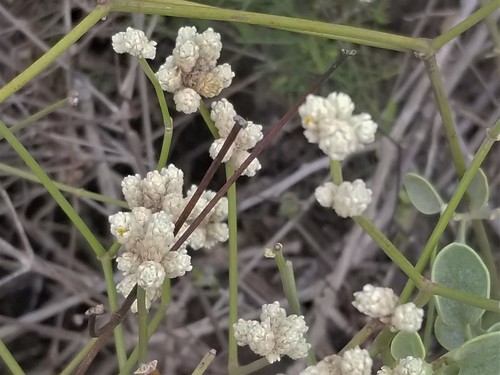
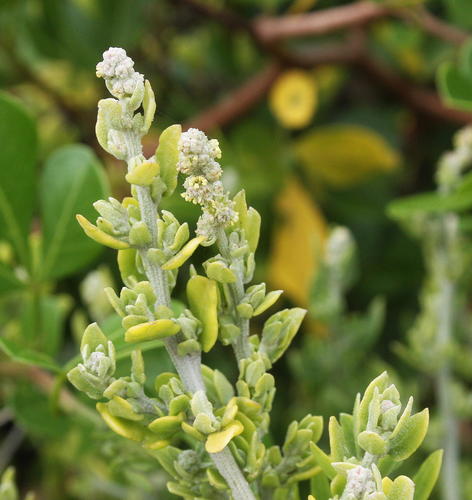
Male (staminate) flowers grow in clusters that form terminal spikes, and each has a 5-lobed perianth.
Male Flower Stamen Structure
Each staminate flower has 5 stamens, with filaments that are fused at their bases.
Female Flower Placement
Female (pistillate) flowers are scattered irregularly among the staminate flowers.
Female Flower Bracteoles
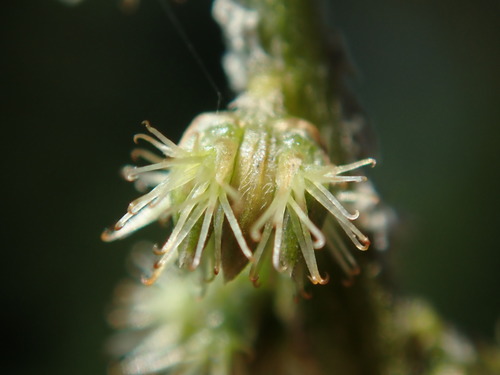
They are surrounded by 2 cylindrical bracteoles, small modified leaves, that are accrescent, meaning they increase in size as the fruit develops.
Fruit Shape
The fruit, or seed capsule, is beaked at the top.
Fruit Pericarp
It has a fleshy pericarp, the fruit wall, that is adherent to internal structures.
Seed and Embryo Structure
The seeds are vertical, and contain an annular, ring or circle-shaped embryo.
Embryonic Root Orientation
The radicle, embryonic root, points downward.
Native Distribution Range
This species is native to South Africa, where it occurs in the Cape Provinces and Free State, and it is also found in Namibia.
Habitat and Associated Flora
It grows in arid regions, specifically in low-lying sandy areas, alongside other plant species including Zygophyllum cordiflorum, Z. flexuosum, Z. morgsana, Atriplex semibaccata, Ruschia geminiflora, Ehrharta calycina, Muraltia dumosa, Searsia glauca, Limonium perigrinum, Restio oleocharis and Euclea racemosa.
Lepidopteran Larval Host Role
Ecologically, larvae of the butterfly Brephidium metophis, the tinktinkie blue, feed on this plant.
Rodent Nesting Use
The bush Karoo rat, Otomys unisulcatus, builds its dome-shaped stick nest lodges using stems from Exomis microphylla.
Common Name and Local Medicinal Context
Locally known as 'unvenyathi', Exomis microphylla is used as a folk medicine in Alice, South Africa.
Leaf Decoction for Reproductive Conditions
A decoction made from its leaves is used as a remedy for endometritis and vaginitis.
Cape Khoi Traditional Medicinal Uses
The Cape Khoi people used leaf decoctions mixed with milk to treat epilepsy, internal winds, cramps, and convulsions in infants.