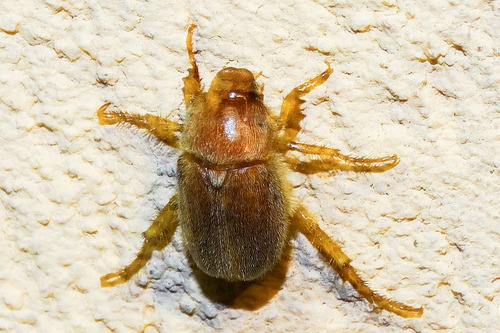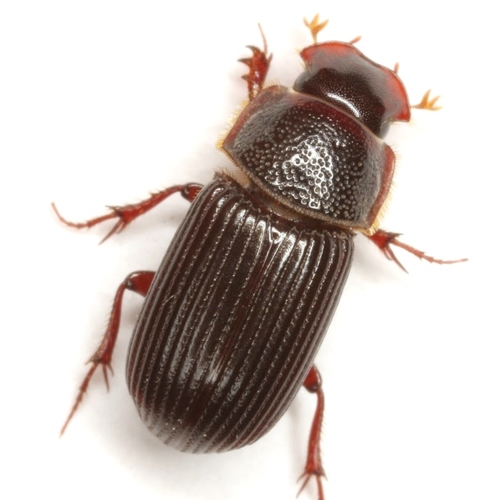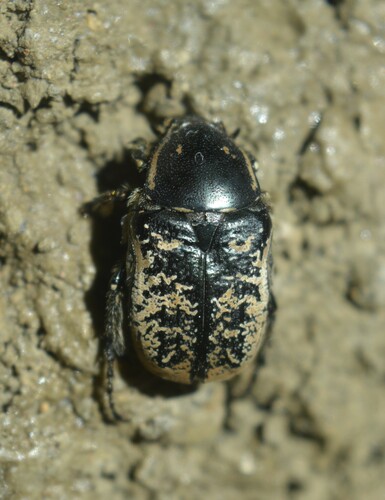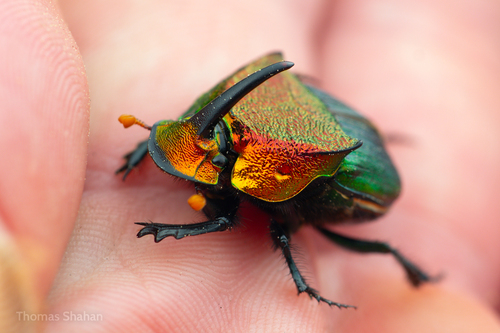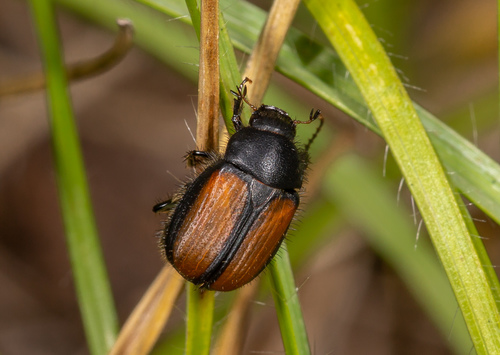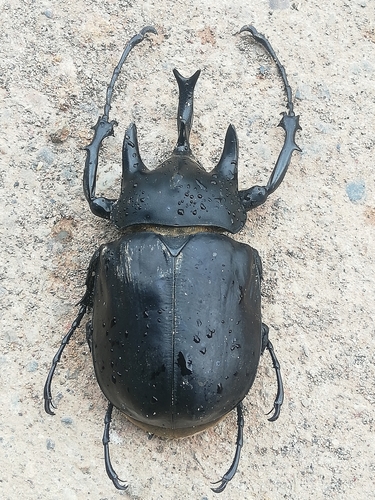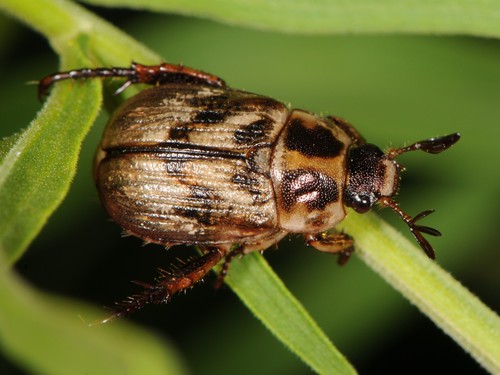
About Exomala orientalis (Waterhouse, 1875)
Exomala orientalis (Waterhouse, 1875) has the scientific synonym Anomala orientalis, and is commonly called the oriental beetle (often abbreviated to OB). It is a species of shining leaf chafers (subfamily Rutelinae) in the scarab beetle family Scarabaeidae. Adult oriental beetles measure 0.7–1.1 cm (0.3–0.4 inches) long, with mottled, metallic brown-and-black elytra, and similarly colored thorax and heads; they are sometimes confused with the larger, more colorful Japanese beetle. In the larval stage, oriental beetles can be identified by their parallel line raster pattern. This species is native to Asia, where it was first collected and documented in Japan in 1875. It later spread to other parts of Asia including Korea, and was eventually introduced to the United States. It was first recorded in Hawaii, then spread to northeastern U.S. states including Connecticut, Maine, and New York, as well as the southern state of North Carolina. Oriental beetles are well-known plant pests that attack a range of plants including sugarcane, maize, and pineapple. In their larval stage, they burrow through soil in agricultural fields and chew through plant roots; infestations remain an ongoing problem targeted by pesticide use. Oriental beetles have a short two-month mating season running from mid-June to mid-August. Outside of mating season, they normally live burrowed deep in soil. During mating season, females emerge from the ground and release a sex pheromone that attracts males, which the males use to locate females. After mating, females return underground to lay their eggs, where larvae mature and begin feeding on plant roots, continuing the pest life cycle. This species is native to Japan, and was introduced to the Hawaiian island of Oahu around 1908, where it is a known garden pest that feeds specifically on sugarcane (Saccharum officinarum). It was first recorded on the U.S. mainland in New Haven, Connecticut. As of 2019, it has been found in 12 U.S. states, with most of the mainland U.S. population concentrated in New York, with additional populations in North Carolina. While the species has spread across North America, most of its total global population remains concentrated in East Asia, including Japan, Korea, Taiwan, and the Philippines. Oriental beetles typically live buried in soil. Outside of mating season, males are most often found along the ground on bushes, shrubs, and other low-growing plants, while females are often found on flowers including roses, chrysanthemums, hollyhocks, phlox, dahlias, and Japanese iris. Feeding on these flowers provides females with extra nutrients that allow them to lay an additional 5.46 ± 0.96 fertile eggs. During mating season, beetles move above ground to mate, but quickly return to the soil once copulation is complete. Females lay their eggs underground, where the eggs develop and mature. When soil temperatures reach 50 °F, newly emerged larvae burrow down to depths of 8 to 17 inches into the soil; larvae can also move horizontally up to 4 feet. This ability to move significant distances lets larvae infest large gardens and turf areas, where they continue moving through soil and feeding on plant roots. The species' preference for living in soil limits its natural ability to spread across large geographic distances, as even when above ground, adults do not tend to fly very far. Its long-distance spread from Asia to North America occurred through accidental transport: the species spread to new locations via infested contaminated nursery plant stocks, including infested shipments of rose blossoms and other flowers.