About Excoecaria agallocha L.
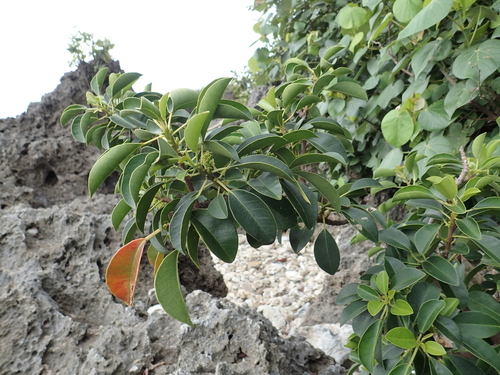
Mangrove swamps are a type of coastal wetland located in the tropics and subtropics. In mangrove forests, the most salt-tolerant species grow closest to the ocean. Excoecaria agallocha is classified as a back mangrove, growing at higher elevations farther inland from the ocean where salinity levels are lower. Mangroves of this species grow around the ancient Thillai Chidambaram Temple in Tamil Nadu. This is a small tree species that can grow up to 15 m tall. Individuals are either male or female, making the species dioecious. Male flowers form drooping tassels, while female flowers grow as shorter spikes. Bees and other pollinators commonly visit these flowers. The fruit of this plant is a small dark capsule. The milky latex of Excoecaria agallocha is highly poisonous and strongly irritant, a trait common for milky species in the plant family Euphorbiaceae. Contact with human skin causes irritation and rapid blistering, and even minor contact with the eyes can cause temporary blindness. This effect on vision is reflected in the species common names; the generic name Excoecaria even comes from the Latin word for "blinder". William Bligh mentioned in his book Voyage to the South Sea that he knew of this hazard before he began the voyage that ended in the famous mutiny on the Bounty. He learned of the plant's toxicity in 1777 from Captain James Cook, when Bligh served as Cook's sailing master. Several men Cook had sent ashore to cut wood were temporarily blinded by the plant. Bligh therefore instructed his men not to cut this type of tree when they went ashore in Tahiti to collect wood and water in 1789. This precaution was well founded, because even smoke from burning this wood is poisonous and can injure the eyes, so the wood is not useful as fuel. The latex produced by E. agallocha contains multiple phorbol-like toxins, including excoecariatoxin, that are powerful irritants to the skin, eyes, and mucous membranes. Despite this plant's strong chemical defenses, E. agallocha is the only food source for larvae of the mangrove jewel bug (Calliphara nobilis), a phytophagous jewel bug species that lives in tropical mangrove forests in parts of Asia. Like many other aposematic scutellerid species, C. nobilis can sequester toxic chemical compounds from its host plant to use in its own defenses against predators. These chemical compounds are concentrated and stored in a pair of scent glands located on the metathorax of both adults and nymphs. When the insects are threatened or handled, they can secrete an irritating, toxic fluid from these glands to deter potential predators. Even dried and powdered leaves of Excoecaria agallocha retain their poison, and can kill fish very quickly or be used to poison dart tips. Excoecaria agallocha has been found to have various medicinal and pharmacological benefits, including use in the treatment of epilepsy, ulcers, leprosy, rheumatism, and paralysis. This plant species has a notably complex chemical composition.