About Evarcha michailovi Logunov, 1992
Evarcha michailovi Logunov, 1992 is a small jumping spider species. Its body is split into two main, egg-shaped or ovoid sections: a more rounded cephalothorax and a more oval abdomen.
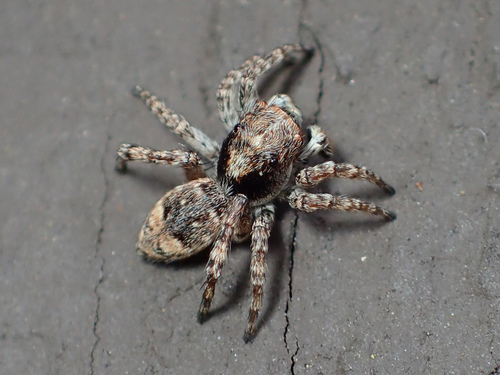
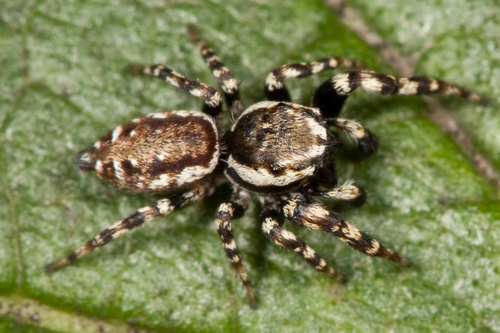
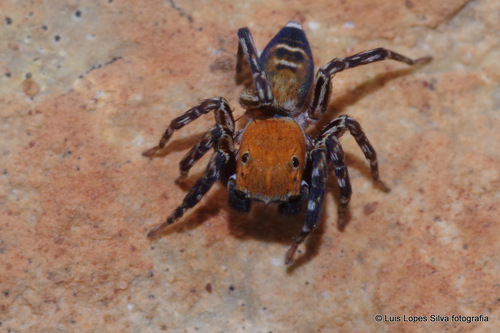
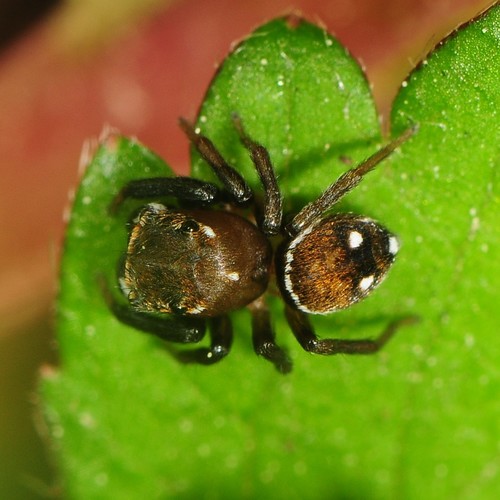
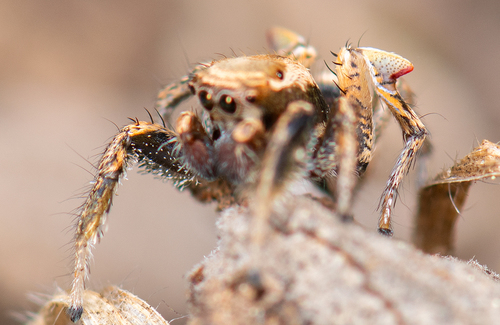
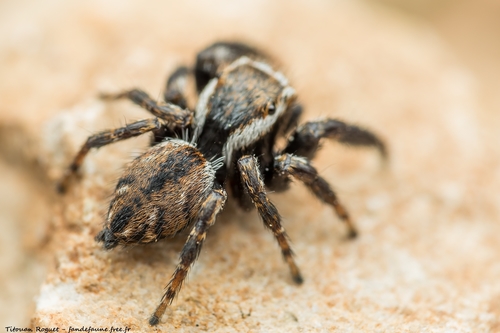
For male individuals, the hard upper section of the cephalothorax (called the carapace) measures 2.08–2.85 mm (0.08–0.11 in) long and 1.53–2.13 mm (0.06–0.08 in) wide. It is typically dark brown to brown, and some specimens have two white stripes running down its sides. The eye field is black, with a white stripe crossing the line of the eyes. The underside of the cephalothorax (called the sternum) is orange-brown. The clypeus is orange, covered in thin white and orange hairs. The spider's mouthparts, which include the chelicerae, labium, and maxillae, are generally orange-brown. The male abdomen is 1.88–2.75 mm (0.07–0.11 in) long and 1.24–2 mm (0.05–0.08 in) wide. The top of the abdomen is usually dark grey, but its pattern varies between individuals. Some males have an abdomen marked with a dark longitudinal line that holds two white oval spots towards the front, plus black lines across the sides. Many males have patterns of whitish-grey and blackish-brown spots on a greyish-brown base, or randomly arranged dark and light patches. The underside of the abdomen is lighter, with a uniform light brown-grey color. The covers of the book lungs and spinnerets are brownish-grey. Male legs are brown with yellowish tarsi, and the front legs are longer and wider than the posterior legs.
Female spiders are slightly larger than males. Their carapace is 2.38–2.75 mm (0.09–0.11 in) long and 1.8–2 mm (0.07–0.08 in) wide, and their abdomen is substantially larger, measuring 3–3.13 mm (0.12–0.12 in) long and 1.5–1.65 mm (0.06–0.06 in) wide. Females are generally lighter in color than males, and a larger proportion of their legs are yellow. In some specimens, the upper surface of the abdomen has a pattern of light and dark patches on a brown background.
This species has distinctive copulatory organs. In males, the palpal tibia is wide, with a large, blunt protrusion called a tibial apophysis. The palpal bulb is round with a flattened end at its bottom, and a thick embolus extends from its top. The cymbium is rather large and encloses most of the bulb, with small hairs covering the cymbium and tibia. In females, a pronounced plate at the front of the epigyne frames the two copulatory openings. These openings connect via short, wide insemination ducts to irregularly shaped spermathecae (receptacles) that have small accessory glands.
The wider Evarcha genus is found across the globe. Evarcha michailovi was originally considered a Siberian species, but is now known to live across large areas of Russia, China, Central Asia, Kazakhstan, Europe, and Turkey. The male holotype was collected in 1988 in the Sayano-Shushenski Nature Reserve, Russia, within the Sayan Mountains. Additional early specimens were collected from other areas of the Altai-Sayan region, often at high altitudes. For example, a female was discovered near Todzha Lake in the Azas Nature Reserve at 900 m (3,000 ft) above sea level in 1989. The first specimen recorded in Kazakhstan was collected the following year in the Saur Mountains, at 1,800 m (5,900 ft) above sea level. The species has also been observed in Kyrgyzstan (first recorded in 1991 along the Arshan river in the Terskey Ala-too mountains) and in Turkmenistan, in the Kopet Dag mountains. The first specimens identified outside the Soviet Union were recorded in 2001 from Tacheng, Xinjiang, China, alongside specimens from Bayantsogt and Bayan-Uul in Mongolia; the Mongolian specimens were originally collected in 1982 but had been misidentified. The species was later found in Turkey, first in the village of Kavalcık, Reyhanlı, Hatay Province in 2007. Its distribution was extended into Europe in 2004 by Jean-Claude Ledoux and Michel Emerit. The first confirmed European specimens, collected in 1986 in Les Eyzies, Dordogne, France, included one female, one male, and four juveniles. Additional French specimens have been identified in Gard, Hérault, and Pyrénées-Orientales. The distribution was further extended into the Balkans in 2010, when specimens were recorded 1.1 km (0.68 mi) north of Sokolarci in Češinovo-Obleševo, North Macedonia, at 436 m (1,430 ft) above sea level. The species has also been observed in the Dinaric Alps, which extend into Slovenia, at altitudes between 359 and 484 m (1,178 to 1,588 ft) above sea level, as well as in Germany and the Netherlands. The later discovery of the species in Spain confirmed that its range covers the entire European continent.
The first known Evarcha michailovi specimens were found on steppe and along forest edges, living among alder trees and shrubs of the genus Cotoneaster. The species has since been found in a wide range of environments, including alpine climates, steppes, and larch and pine forests. French specimens have been observed in dry meadows, heath dominated by Cistus laurifolius, and grassy dykes. The spider also thrives in dry heathland, even when this heathland forms the undergrowth within coniferous forests. It has also been found in areas of human habitation, including urban areas; some specimens were discovered living at the railway station in Chulym in 1994. This species co-occurs with a wide range of other spider species, including Agelena labyrinthica, Agyneta affinis, Alopecosa barbipes, Alopecosa schmidti, Asagena phalerata, Drassodes pubescens, Haplodrassus dalmatensis, Micaria dives, Pardosa monticola, Philodromus collinus, Sitticus saltator, Theridion uhligi, Xerolycosa miniata, Xerolycosa nemoralis, Xysticus ninnii, Zelotes electus, and Zelotes longipes.