About Evarcha denticulata Wesołowska & Haddad, 2013
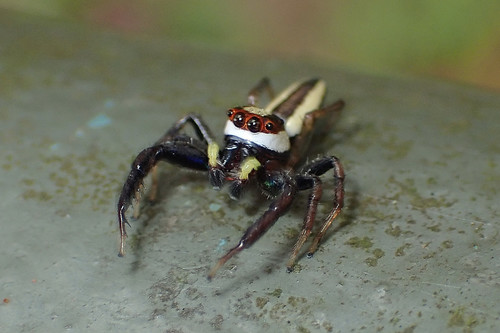
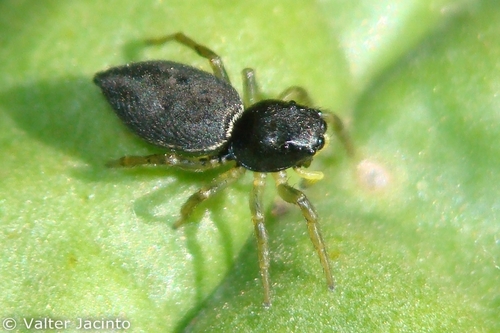
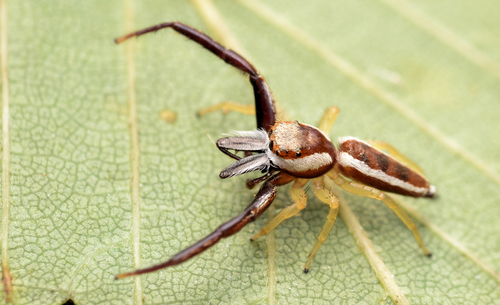
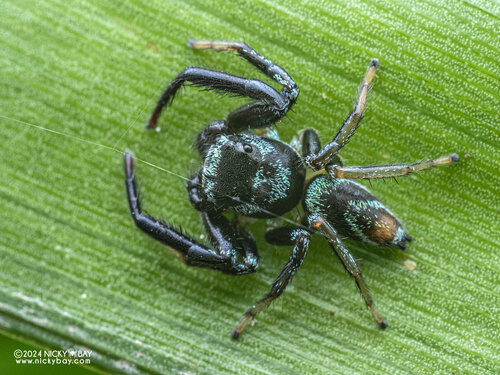
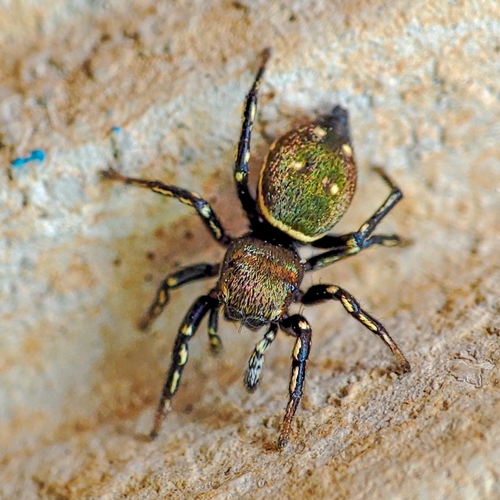
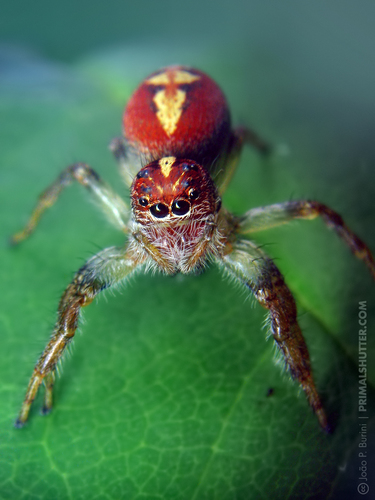
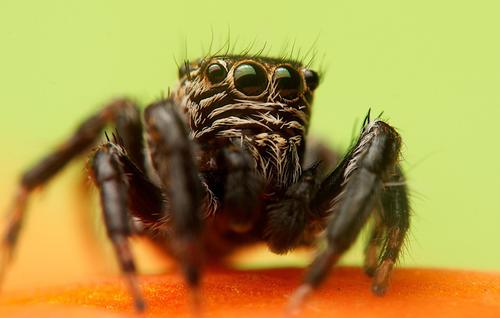
Evarcha denticulata is a small jumping spider species first formally described in 2013 by Wesołowska & Haddad. Its body is split into two main segments: a somewhat rounded, almost rectangular cephalothorax, and a more pointed, ovoid abdomen. For males, the cephalothorax is typically 2.1 mm long and 1.5 mm wide. The carapace, the hard upper section of the cephalothorax, is high, and males usually have a lighter brown flat patch at its center. A line of white hairs separates the eye field from the thorax, and this line extends out onto the carapace. Long brown bristles cover the eye field, with fawn and white scales positioned right near the eyes. The sternum, the underside of the cephalothorax, is dark brown. The clypeus bears a few long white bristles, and the cheeks are marked by white hairs arranged in three distinct lines. The mouthparts, including the chelicerae, are dark brown. The male abdomen is typically 1.8 mm long and 1.2 mm wide. Its dorsal surface is blackish-brown, marked with a pattern of white hairs that forms a streak along the front edge and a band across the middle, broken into large spots toward the rear. The underside is dark, with pale dots arranged into four grey lines, and the spinnerets are also dark. Legs are dark brown, covered in mostly dark brown hairs and spines, with a small number of lighter hairs. The species can be distinguished from other members of its genus by examining the male’s copulatory organs. The male pedipalps, sensory organs located near the mouth, are dark brown. The cymbium is hairy, and the palpal bulb is rounded and bulbous, with a large bulging protrusion at its base and a sharp embolus that projects from the top of the bulb. The palpal tibia has a cluster of long hairs and a long protrusion called the tibial apophysis, which has a flattened end and a tooth protruding from its bottom. Evarcha denticulata resembles the related species Evarcha vittula, but differs from it in the shape of the tibial apophysis and the T-shaped marking on the abdomen. Females are slightly larger than males. A female’s cephalothorax measures between 2.4 and 2.5 mm long and 1.8 and 1.9 mm wide, while its ovoid abdomen measures between 3.1 and 3.4 mm long and 2.5 and 2.7 mm wide. The female carapace is high and brown, with blackish areas and white patches near the eyes; the hairs that make up these white patches radiate in lines down the slopes of the carapace. Both the upper and lower sides of the cephalothorax are light brown. Females share the male’s long white bristles on the clypeus and white lines on the cheeks. Like males, female mouthparts including the chelicerae are dark brown, but the labium and maxillae have pale tips. The female abdomen is larger and lighter in color than the male’s. It is yellowish on the dorsal surface, marked with a pattern of oblique streaks formed by dark grey patches, and light yellow with greyish patches on the underside. Long white bristles sit at the very front of the abdomen, and dark spinnerets are found at the rear. Female legs are mostly light brown with some darker segments, covered in many spines and brown leg hairs. Females also have distinctive species-specific copulatory organs: the small epigyne has a very wide pocket in the epigastric furrow at its rearmost point. The two copulatory openings lead to relatively short, wide insemination ducts and spermathecae (receptacles) that have thick walls and strong sclerotization. While the genus Evarcha is found across the world, individuals recorded in North America are likely accidental migrants carried via ocean shipments. The genus is particularly common in Africa and East Asia. Evarcha denticulata is endemic to South Africa. The male holotype was collected 10 km from Paterson in the Eastern Cape in 2011, found on a grassy tussock. Additional specimens have been found in urban areas of Cape Town in the Western Cape and at high altitudes up to 1,270 m above sea level in the Amathole Mountains. The first identified female specimen was collected in Fisherhaven in 2004, and the species has since been observed in Jeffrey’s Bay and the Amathole Mountains as well. This is a ground-dwelling spider that lives in leaf litter and grasslands within fynbos habitats, and is often found underneath overhanging vegetation.