About Eutrochium purpureum (L.) E.E.Lamont
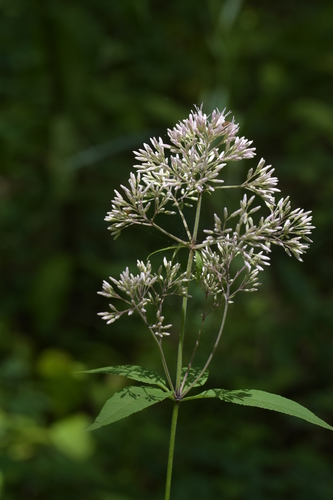
Eutrochium purpureum is a clump-forming herb that grows 1.5–2.4 meters (4.9–7.9 ft) tall, and reaches approximately 1.2 meters (3.9 feet) wide. It grows in locations with full sun to part shade, in mesic to wet soils. Its stems are upright, thick, round, and purple, with whorls of leaves growing at each node. As the plant starts to bloom, stems often bend downward under the weight of its flowers. Leaves can grow up to 30 cm (12 in) long and have a somewhat wrinkled texture. This species produces purplish flowers in large, loose, convex compound corymbiform arrays. It blooms from mid to late summer, and attracts high insect activity from animals that feed on its floral nectar.
In its ecology, many species of butterflies, moths, bees, and flies visit the flowers of Eutrochium purpureum. It acts as a larval host for four moth species: the eupatorium borer moth (Carmenta bassiformis), the red groundling moth (Perigea xanthioides), the ruby tiger moth (Phragmatobia fuliginosa), and the three-lined flower moth (Schinia trifascia). Larvae of the leaf miner fly Calycomyza flavinotum create blotch-shaped mines on the plant's leaves.
In cultivation, like other species in the Eutrochium (Joe Pye weed) genus, Eutrochium purpureum is grown as an ornamental landscape plant, and has escaped from cultivation in parts of New Zealand. E. purpureum and E. maculatum (spotted Joe Pye weed) are sometimes confused with one another or used interchangeably in gardening due to their similar appearance.