About Eutrema japonicum (Miq.) Koidz.
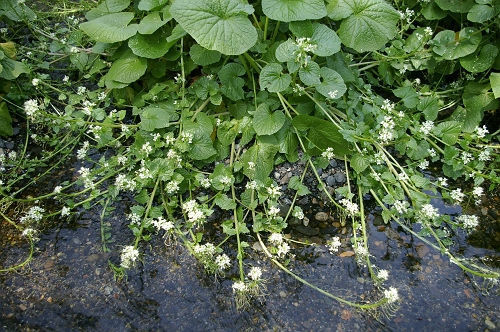
Eutrema japonicum (Miq.) Koidz., commonly known as wasabi, produces large leaves from long, thin stalks. These are simple large leaves, measuring 3–6 inches (7.6–15.2 cm) in both length and width, and have palmate veins. Wasabi can be categorized by cultivation style. "Field wasabi" (hatake wasabi) is grown in open fields, while "water wasabi" (sawa wasabi) is cultivated in a semiaquatic system in stream beds. Semiaquatic cultivation is the traditional method used in Japan, and water wasabi is valued for its large rhizome. Large-scale wasabi cultivation requires very specific suitable conditions, and the crop is difficult to grow even when conditions are ideal. In Japan, wasabi is mainly cultivated in four regions: Izu Peninsula in Shizuoka Prefecture, where "Traditional Wasabi Cultivation in Shizuoka, Japan" is recognized as both a Globally Important Agricultural Heritage System and a Japanese National Important Agricultural Heritage System; Nagano Prefecture, home to the Daio Wasabi Farm in Azumino, a popular tourist attraction and the world's largest commercial wasabi farm; Iwate Prefecture; and Shimane Prefecture, which is known for its Hikimi wasabi. Traditional wasabi cultivation can be considered an early form of hydroponics, using an open, soilless system. Modern hydroponic techniques are also used to grow wasabi. General principles for this soilless culture cover selecting a cultivation system, for example drip irrigation on substrates such as rockwool, perlite, or coconut coir; choosing between open and closed systems, where closed systems treat or disinfect return flow using ultraviolet radiation (UV), ozone, or filtration; and the automated control of pH and nutrient composition through fertigation. These modern hydroponic methods ensure stable oxygen and water availability in the root zone and reduce nutrient losses.