About Euthalia phemius Doubleday, 1848
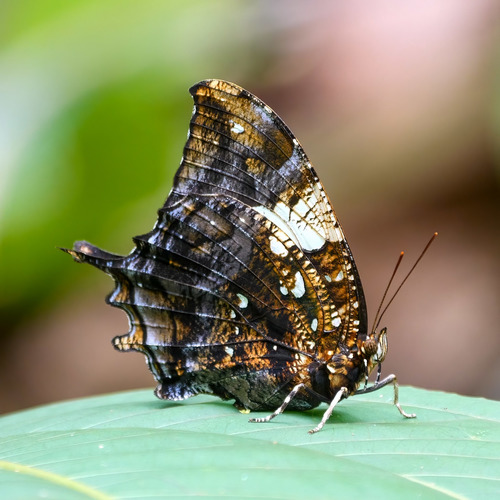
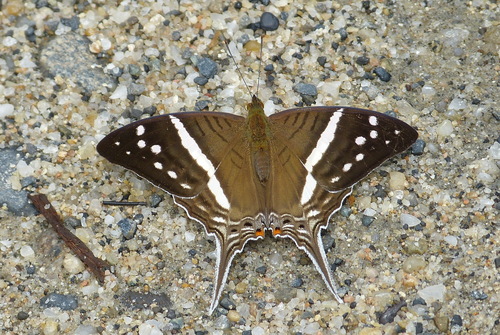
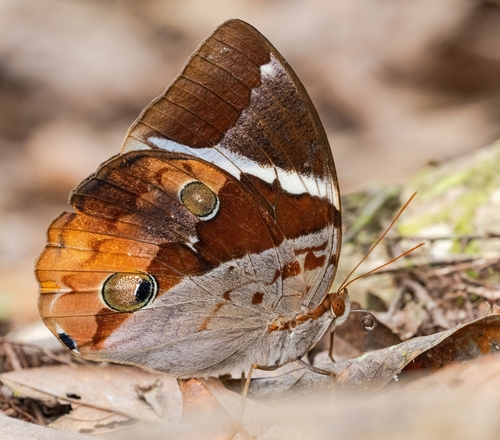
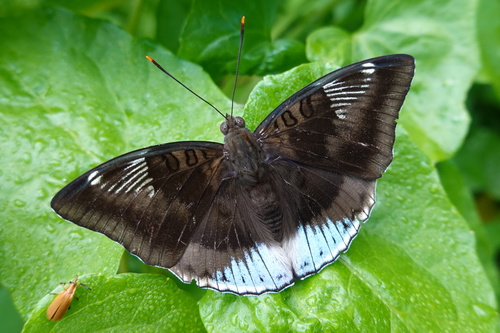
Euthalia phemius, commonly known as the white-edged blue baron, is a butterfly species belonging to the family Nymphalidae. It is distributed in Sikkim, Assam, Myanmar, southern China (including southern Yunnan and Hong Kong), Peninsular Malaya, and Indo-China. The wingspan of this species ranges from 60 to 85 millimeters, and it shows distinct marked sexual dimorphism. Both sexes have a brownish base color on the upper sides of their wings, and their wing anal angle is pointed. In males, a distinct radiating whitish line pattern is present in the postdiscal region of the forewings, and there is a light blue region edged in white above the inner margin of the hindwings — this marking gives the species its common English name, the White-edged Blue Baron. Females differ from males by having a white band that runs from the middle of the forewing's leading edge to the inner angle, and they lack the blue region on the hindwings. For both sexes, the undersides of the wings are ochre to reddish-brown, and match the white markings found on the forewings' upper sides. Mature caterpillars of Euthalia phemius are green, with a yellow dorsal line, spiky outgrowths extending laterally from each body segment, and resemble twigs of their host foodplant. This butterfly primarily lives in moist deciduous forests. Adults fly year-round, but are most active during June and July. They prefer to feed on damp soil to get moisture and minerals. Caterpillars feed on the leaves of lychee trees (Litchi chinensis) and mango trees (Mangifera indica).