About Euthalia nais
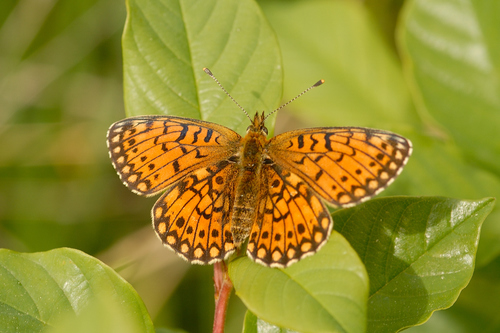
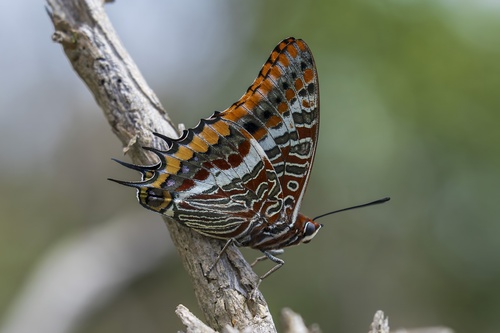
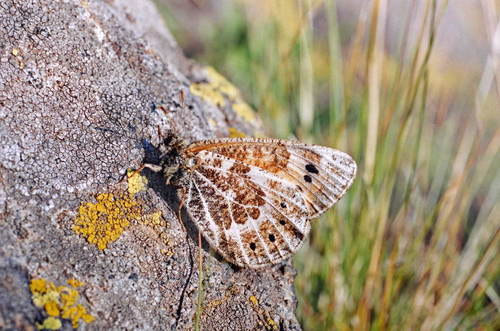
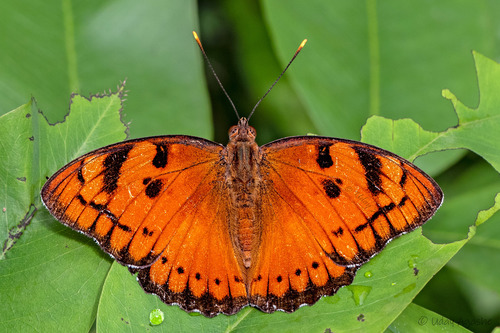
Euthalia nais. Both males and females have tawny-yellow uppersides. The forewing has a transverse black line below the apex cell, an oval spot beyond that encircles a small yellow spot, a broad short oblique discal bar, and an angulated postdiscal lunular band; the costa is narrowly shaded black, and the termen is also shaded black. The hindwing has black markings: a comparatively large triangular patch below the middle of the costa, a postdiscal evenly curved series of spots, and a broad black band along the termen. The underside is dark ochraceous red. The forewing underside has a base shaded with fuscous black; two spots at the base of the cell and a transverse line beyond these spots are crimson pink, edged with black. There is a very broad oblique discal band, angulated downwards below vein 4, that is bordered posteriorly by a large black spot on the inner side and outwardly and anteriorly by an oblique broad black band. This is followed by four anterior obliquely placed ochraceous-white spots, and beyond these spots lies a very narrow lunular black band bent downwards below vein 6. The hindwing underside has a short crimson line at the extreme base, and two crimson black-bordered spots in the cell. It has a comparatively broad transverse discal white band that is often broken up into a large spot below the middle of the costa, with two or three spots in line below this large spot, and finally a postdiscal series of small black spots. Antennae are black, bright ochraceous at the apex. The head, thorax, and abdomen are tawny red above, and brown shaded with crimson-pink below. This species is widely found in India and Sri Lanka. In India, its distribution ranges from the lower Himalayas to southern India.