About Euthalia lubentina Cramer, 1779
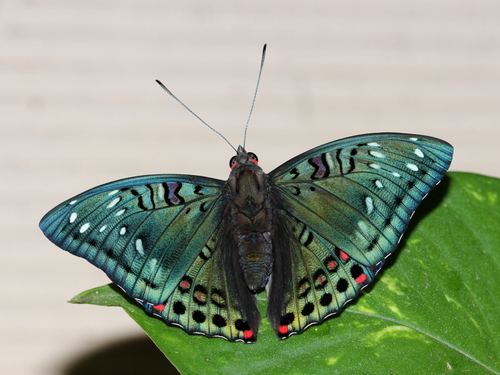
Description of male Euthalia lubentina: Upperside is dark greenish brown. On the forewing, one bar across the middle and one bar beyond the apex of the cell are crimson with black borders. A slightly oblique transverse discal series of small white spots runs from the costa to interspace 1, followed by a preapical curved row of four similar spots and a transverse subterminal series of elongate black spots that form an obscure band. On the hindwing, there is a crescent-shaped black loop near the apex of the cell area. A curved postdiscal series of four or five crimson spots has black outer borders; the subcostal spot is the largest. This is followed by a subterminal series of velvety-black subquadrate spots, with the anterior three and the tornal spot crimson on their outer sides. Underside is dark purplish brown, slightly suffused with ochraceous. Markings match the upperside but are larger and more clearly defined, with additional features: forewing has two small black spots at the base, and the basal half of the costal margin is crimson; hindwing has four black-bordered crimson spots at the base, crimson costal and dorsal margins, one extra spot in the postdiscal series, and the velvety-black spotting seen on the upperside is more or less obsolete. Antennae are dark brown, with the club crimson underneath. The head, thorax and abdomen are dark greenish brown; underneath, the palpi and forelegs are crimson, and the remaining structures are pale brown. Description of female Euthalia lubentina: Similar to the male, but overall paler. On the upperside forewing, the transverse crimson bands in the cell are obscure, with a broad black-bordered white band interposed between them. The discal series of white spots are very large and very irregular in shape. On the hindwing, the ground colour is suffused with greenish blue across the terminal posterior half of the wing; markings are the same as in the male. Underside is brown, with the tornal half of the hindwing bluish green. Forewing markings match the upperside, plus there are two small black spots at the base and an obscure broad terminal pale band. Hindwing has four black-bordered transverse crimson spots at the base, in addition to the same markings seen on the male's upperside. Antennae, head, thorax and abdomen match the male, but are paler; the underside of the palpi has a pink stripe, and the forelegs are whitish. Distribution: Found in the lower foot-hills of the Himalayas from Haridwar to Sikkim, with records from Mussooree at 10,000 feet (3,000 m); also occurs in Oudh, Bengal, and ranges eastward through Bhutan, Assam, Cachar to Myanmar, Tenasserim, Siam, the Malay Peninsula and Sumatra. In continental India, it is found southward from Bombay.