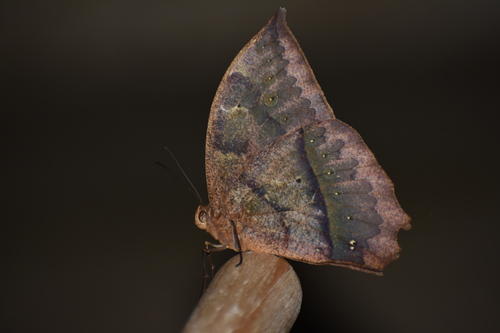
About Euthalia aconthea Cramer, 1779
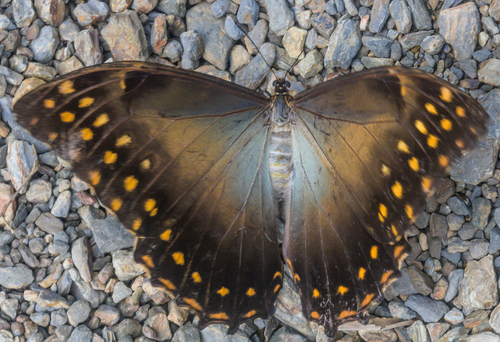
Euthalia aconthea Cramer, 1779 is a butterfly species with distinct male, female, and described geographic races. Males have an olive-tinged brown upperside. On the male forewing upperside, there are two short transverse black lines at the base, a black loop across the middle, and another black loop beyond the apex of the cell, all with dark brown centers. These markings are followed by an angulated dark brown discal band, which is outwardly bordered by a series of five white spots. Two additional preapical white spots sit beyond this band, plus a broad, somewhat diffuse subterminal black band that broadens over the apex and angles inward in interspace 1. The male hindwing upperside is shaded dark brown at the base, with two crescent-shaped dark brown loop-like marks inside the cell; it also has a discal series of dark brown, elongate, outwardly acute, inwardly diffuse, somewhat spear-shaped (hastate) spots, followed by a subterminal series of small dark brown spots. The underside of both wings is ochraceous brown. On the male forewing underside, five slender transverse black lines cross the cell, with a black spot below the median vein. The discal and preapical white spots match those on the upperside, and are followed by a postdiscal series of somewhat diffuse crescent-shaped black marks, plus a broad terminal pale lilac band that does not reach the apex, and is narrowly bordered with dark brown along the termen. The male hindwing underside has four or five slender black loops at the base, a posteriorly obsolescent postdiscal series of diffuse black marks, a subterminal series of black dots, and pale lilac shading on the termen near the apex. Antennae, head, thorax, and abdomen are dark brown; antennae are ochraceous at the tip, and the underside of the body is paler. Females are similar to males but have an overall paler shade. On the female forewing upperside, the dark discal and subterminal bands found in males are absent, and the discal spot series is elongate and much larger. On the female hindwing upperside, the discal series of outwardly pointed black markings are only present as traces. The female underside matches the male underside, but the ground colour is more ochraceous, and markings are larger and more diffuse. The caterpillar of this species is green, with a blue-yellow line along its back that helps it camouflage against leaves. Branching spines protrude from its dorsal surface, covering the entire caterpillar except for the line along its back. The spines lie flat against the leaf, which is also the caterpillar's food source. Race vasanta (Moore), found in Sri Lanka, resembles the nominate race. In male race vasanta, the forewing white spots are entirely absent on both the upperside and underside. The discal band on both the forewing and hindwing upperside is more irregular and much less well-defined. On the forewing, the interspace between the discal band and the subterminal band is suffused with dark green; on the hindwing, the posterior half is suffused with dark green. The terminal margin of the forewing and the anterior half of the hindwing are tinged with pink. The underside matches the nominate race, but both the ground colour and markings are paler, and markings are less prominent. Female race vasanta differs noticeably on both the upperside and underside: the discal row of white spots is more oblique and complete, extending from the costa to near the apex of interspace 2. Race acontius is found in the Andaman Islands. The species' wingspan ranges from 68–79 mm (2.7–3.1 in). In 1905, Charles Thomas Bingham recorded this species' range as throughout peninsular India, except for desert tracts and the higher Himalayan ranges; it is also found in Assam, Burma, and Tenasserim, with its range extending to the Malay Peninsula and Sumatra. Larval host plants include Anacardium occidentale, Scurrula, and mango (Mangifera indica).