About Euscarthmus meloryphus Wied-Neuwied, 1831
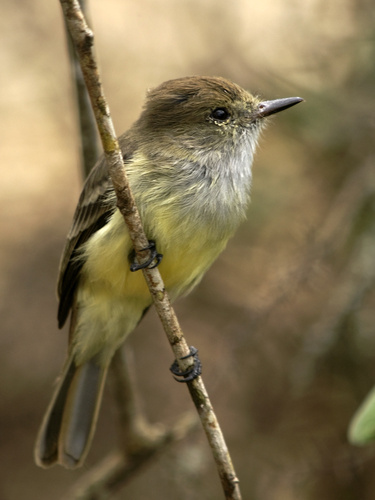
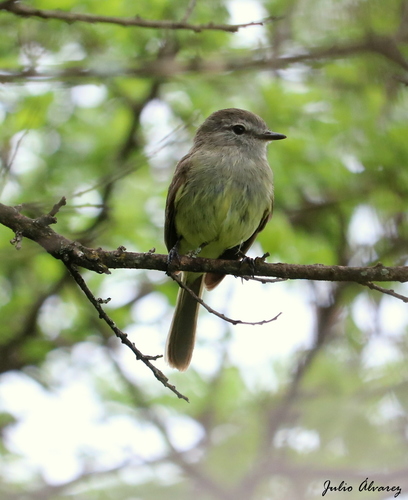
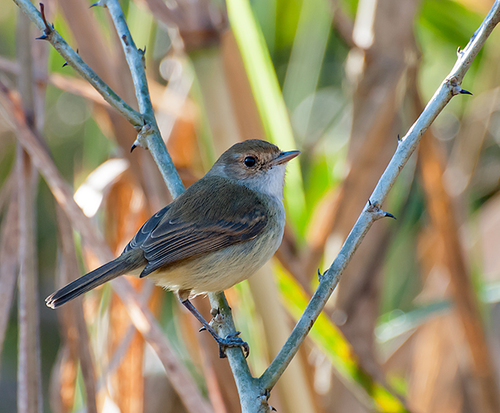
The fulvous-crowned scrub tyrant (scientific name: Euscarthmus meloryphus Wied-Neuwied, 1831) measures 9 to 12 cm (3.5 to 4.7 in) in length and weighs 5 to 10 g (0.18 to 0.35 oz). Both sexes share identical plumage. For adults of the nominate subspecies, the crown is drab brownish with a weak crest, and partially hidden rufous feathers run down the center of the crown. The face is mostly buffy brown, with dull buffy to whitish lores and an indistinct dull buffy to whitish eye-ring. The upperparts are drab brownish. The wings are dusky brown, with rufous tips on the coverts and less distinct rufous edges on the flight feathers. The tail is dusky. The throat and breast are grayish white, with a brownish tinge on the sides of the breast and flanks. The remaining underparts are creamy yellow. Subspecies E. m. paulus is very similar to the nominate, except it has a fulvous to buffy face. For both sexes of both subspecies, the iris is medium brown to chestnut or cinnamon; the maxilla is black; the mandible may be grayish to white, pale brownish pink, or entirely plumbeous gray; and the legs and feet can be any of several shades of gray.
The fulvous-crowned scrub tyrant has a disjunct distribution, and its two subspecies are widely separated from each other. The nominate subspecies occurs further south and has a larger range. It is found in Brazil, from Maranhão and Ceará south to Mato Grosso and Rio Grande do Sul, then west into northern and eastern Bolivia and extreme southeastern Peru, and south through eastern Paraguay and Uruguay into Argentina. In Argentina, it reaches as far south as Tucumán Province in the northwest, and east to Córdoba and northern Buenos Aires provinces. Subspecies E. m. paulus occurs from Colombia's Magdalena River valley, north and east across northern Venezuela to Sucre state, and south to northeastern Bolívar state.
This species lives in a range of dry to arid, generally open landscapes, including lowland and montane scrublands, shrublands, dry forest edges, and fields and pastures with scattered dense bushes and thickets. In Peru, it inhabits riparian thickets. In terms of elevation, it ranges between sea level and 1,000 m (3,300 ft) in Colombia and Venezuela, between sea level and 1,500 m (4,900 ft) in Brazil, and up to 1,200 m (3,900 ft) in Bolivia.