About Eurypyga helias (Pallas, 1781)
General Plumage Coloration
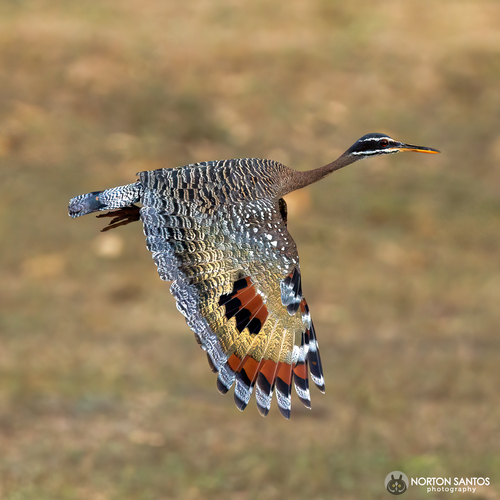
The sunbittern, Eurypyga helias (Pallas, 1781), generally has subdued coloration with fine linear patterns in black, grey, and brown. However, the middle webs of its remiges are vividly colored; when the wings are fully spread, these form bright red, yellow, and black eyespots.
Eyespot Function
Sunbitterns display these eyespots to other sunbitterns during courtship and threat displays, and also use them to startle potential predators.
Sexual Dimorphism Cues
Small differences in feather patterns on the throat and head allow differentiation between adult male and female sunbitterns.
Specialized Feather Structure
Like some other bird species, the sunbittern has powder down.
Bill and Foot Morphology
It has a long, pointed bill that is black on the upper mandible, and a short hallux similar to that of shorebirds and rails.
East Andes Lowland Subspecies Traits
The South American lowland subspecies found east of the Andes has mainly brown upperparts, with orange-yellow legs and lower mandible.
Other Subspecies Traits
The other two subspecies are greyer on their upperparts, and their legs and bills are sometimes redder.
Overall Species Range
The sunbittern’s overall range stretches from Guatemala to Brazil.
Nominate Subspecies Distribution
The nominate subspecies, E. h. helias, occurs east of the Andes in lowland tropical South America, from the Orinoco basin through the Amazon basin and Pantanal.
E. h. meridionalis Distribution
The subspecies E. h. meridionalis has a more restricted range, found along the East Andean slope in south-central Peru, in the lower subtropical zone at altitudes between 800–1,830 m (2,620–6,000 ft).
E. h. major Distribution
The third subspecies, E. h. major, occurs across a range of altitudes from southern Guatemala, through Central America and the Chocó, to western Ecuador.
E. h. major Mexico Presence Uncertainty
This subspecies may also be present in southern Mexico; it has been traditionally reported from the Atlantic slope of Chiapas, but no specimens are known and there have been no recent records.
Habitat Preferences
The species inhabits humid Neotropical forests, typically in areas with an open understory located near rivers, streams, ponds, or lagoons.
Anti-predator Behavior
Sunbitterns are cryptic birds that spread their large wings, which have an eye-like pattern, when they feel threatened.


