About Eurybia sibirica (L.) G.L.Nesom
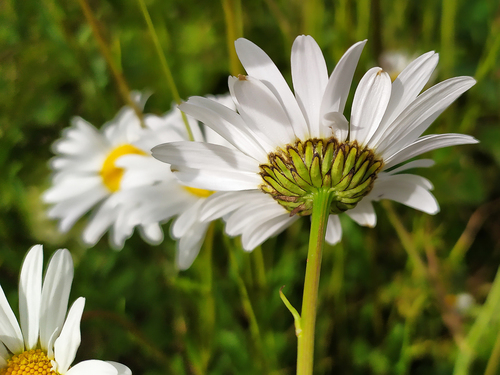
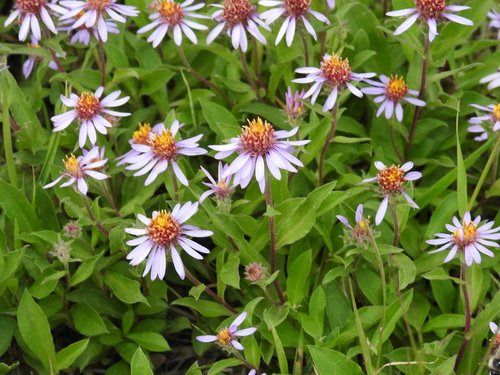
Eurybia sibirica (L.) G.L.Nesom, commonly known as the Siberian aster or arctic aster, is an herbaceous perennial plant native to northwestern North America and northern Eurasia. It grows mainly in open areas of subarctic boreal forests, though it can also be found in a wide range of other habitats across the region. It looks similar to Eurybia merita, but their ranges only overlap near the United States-Canada border, where E. sibirica generally grows at higher elevations. This perennial herb reaches up to 60 cm (2 feet) tall, and spreads via thin underground rhizomes. It produces flower heads either individually or in dense flat-topped clusters holding 2 to 50 heads. Each flower head contains 12 to 50 white, purple, or pale violet ray florets that surround 25 to 125 yellow disc florets. Its involucral bracts are reddish-purple, or anthocyanic. Eurybia sibirica occurs across most of the world’s subarctic region, in northwestern North America, Northern Europe, and Northern Asia. It is common in northern Asia, including Buryatia, Yakutia, Mongolia, Japan, the Chinese province of Heilongjiang, and other parts of northern China. It is also found in European Russia, Scandinavia, northern and western Canada (including Alberta, British Columbia, and all three Arctic provinces), and the United States (including Alaska, plus the mountains of Washington, Idaho, and Montana). It grows at elevations from sea level up to 2200 metres. It prefers sandy or gravelly soils in disturbed or open areas of boreal forests, but can also be found in wet meadows, open areas of aspen and spruce woods, along riparian thickets, sandy or gravelly stream flats, stream banks, lake shores, bluffs, sand dunes and other sandy areas, and both sub-alpine and mountain meadows. Two subspecies are recognized: Eurybia sibirica subsp. sibirica and Eurybia sibirica subsp. subintegerrima (Trautv.) Greuter.