About Eurybia divaricata (L.) G.L.Nesom
Eurybia divaricata (L.) G.L.Nesom is a herbaceous perennial that flowers from late summer to fall. It typically grows 30 to 90 cm tall, though some specimens can reach up to 1.2 m (3.9 ft). Each year, the plant regrows from rhizomes, forming dense clonal colonies that have no sterile rosettes. Its rhizomes are branched and elongated, becoming woody as they age. Each plant produces one simple, flexible erect stem: it is nearly hairless to finely hairy near the base, and densely covered in fine hair toward the stem tips. This species is very similar to and often confused with Eurybia chlorolepis, Eurybia schreberi, and Symphyotrichum cordifolium. E. schreberi can be distinguished by its wider leaves that bear more teeth; E. chlorolepis has more ray florets, longer involucres, and is only found in the southern United States from Virginia to Georgia.
Eurybia divaricata has three morphologically distinct types of leaves: basal leaves at the plant base, cauline leaves growing on the stem from the middle upward, and distal leaves at the stem extremities. All three types are thin and sharply serrated, with 6 to 15 pointed teeth per margin. Leaf margins are ciliate, with small hairy projections along the edge, and leaf tips are acuminate, tapering to a sharp point. The upper (adaxial) leaf surface is nearly hairless or sparsely hairy; the lower (abaxial) surface is sparsely hairy, with veins covered in shaggy villous hairs.
Basal leaves are ovate (egg-shaped) with heart-shaped (cordate) bases. Leaf blades are 1.9 to 6.5 cm long and 1.7 to 6 cm (0.67 to 2.36 in) wide, borne on petioles 2 to 7 cm long, and they wither when the plant begins flowering. Cauline leaves are borne on petioles 2.5 to 7 mm (0.098 to 0.276 in) long that are often winged. Their blades are also ovate, with bases ranging from cordate to rounded, and measure 2 to 20 cm (1 to 8 in) long by 1 to 10 cm (0.5 to 4 in) wide, so they are often much larger than basal leaves. Distal leaves are typically sessile (no petiole), though some are subpetiolate with a very short petiole. Their blades are ovate to lanceolate (lance-shaped) with rounded bases, and measure 0.5 to 2 cm (0.20 to 0.79 in) long by 0.1 to 0.8 cm (0.039 to 0.315 in) wide.
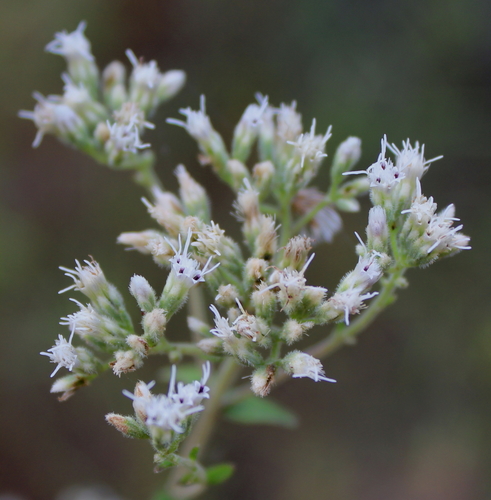
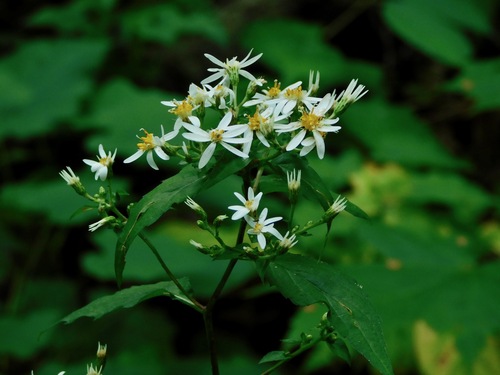
The flower heads (capitula) are arranged in relatively flat-topped corymbiform clusters. A plant can have anywhere from 4 to 50 capitula, and exceptional individuals may have 100 or more. The flower stalks (peduncles) reach up to 1.5 cm (0.59 in) in length and are densely covered in non-glandular hairs. Small bracts at the base of peduncles are usually absent, though up to two may occur in some cases. The involucre, the whorl of small scale-like modified leaves at the base of the capitulum, is shaped between cylindric and bell-shaped (campanulate), and measures 4.2 to 6 mm (0.17 to 0.24 in) long, much shorter than the plant's pappi. The individual modified leaves that make up the involucre (phyllaries) number 25 to 30, arranged in 4 to 5 overlapping series. Inner phyllaries are shaped between linear and lanceolate, with purple coloration toward their tips, while outer phyllaries are more oblong. All phyllaries are strongly unequal in size, with hardened bases, somewhat thin, dry, membranous (scarious) margins that are fringed with hair (fimbriate-ciliate). Their tips range from rounded to pointed (acute), their surfaces are sparsely haired, and sometimes bear sparse stipular glands. Dark green chlorophyllous zones (areas of concentrated chlorophyll) cover the upper half of outer phyllaries, and the upper third or outer midveins of inner phyllaries. Outer phyllaries are typically 0.7 to 1.5 mm (0.028 to 0.059 in) wide, and their length rarely exceeds 2.5 times their width.
Like most species in the Asteraceae family, Eurybia divaricata has two types of florets in each flower head: ray florets with strap-shaped petal-like structures around the head edge, and small disc florets packed at the center. There are 5 to 10 (rarely up to 12) ray florets, with white straps 6 to 12 mm long and 1.5 to 2.2 mm wide. Disc florets number 12 to 19 (up to 25 in exceptional cases), and have yellow fused tubular corollas 4.1 to 4.8 mm long (exceptionally 5.5 mm). The corolla is abruptly enlarged (ampliate), with a tube longer than its bell-shaped throat: the tube measures 2.3 to 2.6 mm, while the throat is only 0.9 to 1.2 mm long. The corolla lobes (the free edges of the throat) are lanceolate, reflexed, and measure 0.7 to 1.4 mm.
The fruit is a brown cypsela (a type of achene), slightly compressed and shaped between cylindric and obovoid (inversely egg-shaped). It measures 2.6 to 3.8 mm (0.10 and 0.15 in) long, is sparsely covered in stiff bristly hairs (strigillose), and has 7 to 10 tan to straw-colored (stramineous) ribs. The pappus, a modified calyx surrounding the fruit, is made of reddish to cream-colored bristles 3.7 to 5 mm (0.15 to 0.20 in) long, equal to or longer than the disc corolla. The bristles are fine and weakly barbed (barbellulate), and may sometimes be slightly club-shaped (clavate) toward their tips.
Eurybia divaricata is primarily native to the Appalachian Mountains in eastern North America, with some populations growing in adjacent lowlands. It grows on dry to mesic sites in eastern deciduous and mixed deciduous woods, as well as woodland edges, clearings, and roadsides. It is most common between 0 and 1,200 m (0 to 3,937 ft) in elevation, though it can grow as high as 1,700 m (5,600 ft). In Canada, it occurs only in Ontario and Quebec, and is considered threatened, with only 25 known locations across the country. In the United States, it is found in all states from Maine south to Alabama, and west to Ohio and Kentucky. This species has also been introduced to Europe, particularly the Netherlands.
Commonly called white wood aster, this species is less popular in cultivation than other asters such as New England aster, but fills a useful niche, especially in North American native plant gardens. It flowers earlier than many other asters, does not require staking, and blooms well in shade. Gardeners value it for its showy white flowers that open in mid to late summer, its low growth habit, hardiness, and low maintenance requirements. It has few issues with disease or insects. It requires partial shade, and performs best with around 4 hours of sunlight per day. Plants can be cut back to 20 cm (8 in) in spring to delay flowering and increase branching. It is marginally hardy in USDA Zone 3, and fully hardy in Zones 4 to 8. It is commonly available in North American nursuries, and several cultivars have been selected: 'Fiesta', selected in Waseca, Minnesota, has white-streaked leaves that resemble confetti and light lavender flowers; 'Raiche Form', found by Roger Raiche, has larger-than-typical white flowers and darker, thin sinewy stems; 'Snow Heron', selected from a chance seedling grown at Heronswood Nursery in Washington, has white flowers and dark green leaves with white splotches and streaks. The young leaves of Eurybia divaricata can be cooked and eaten.