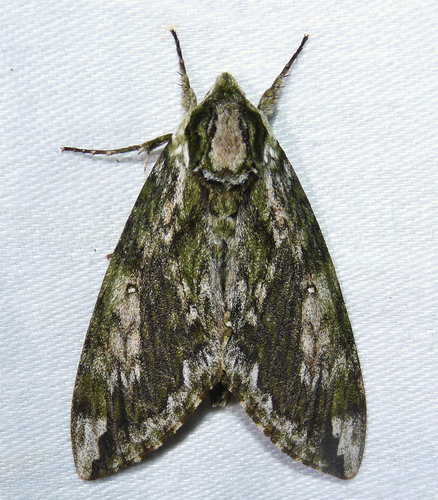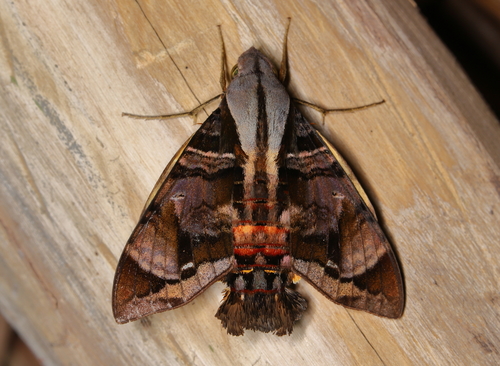
About Eupyrrhoglossum sagra Poey, 1832
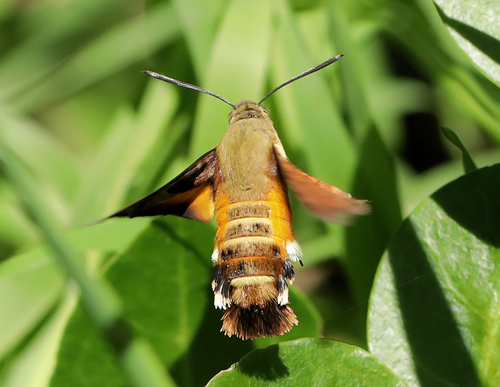
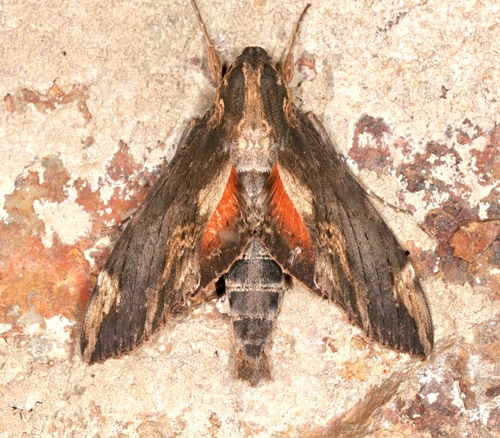
Eupyrrhoglossum sagra, commonly called the Cuban sphinx, is a moth species belonging to the family Sphingidae. This species was first formally described by Felipe Poey in 1832. It is found in tropical and subtropical lowland habitats; its confirmed range includes Cuba, and extends from Mexico and Belize through Guatemala and Costa Rica to Bolivia, Paraguay, Argentina, and Uruguay. Occasional stray individuals of this species have been recorded in Florida. The wingspan of adult individuals measures 51–53 mm. The forewing features a semi-transparent submarginal spot. The head bears a low medial crest, and the thorax is pale grey, which contrasts sharply with the dark brown edges and dark brown median line on the thorax. The upperside of the forewing has a blackish subbasal band, while the upperside of the hindwing has a median yellow band that is nearly even in width. The fringe of the wings is yellow. In tropical regions, adult moths are likely active on the wing year round. In Costa Rica, adults have been recorded in flight year round, with the exception of March. In Venezuela, adult individuals have been recorded in flight during the month of April. The larvae of this moth feed on plant species belonging to the Rubiaceae family, specifically Guettarda macrosperma, Guettarda scabra, and Chomelia spinosa.