About Euptychia cymela Cramer, 1779
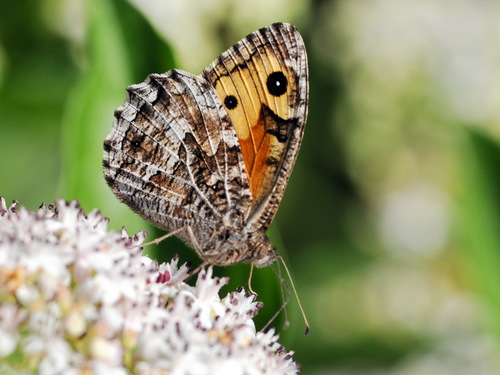
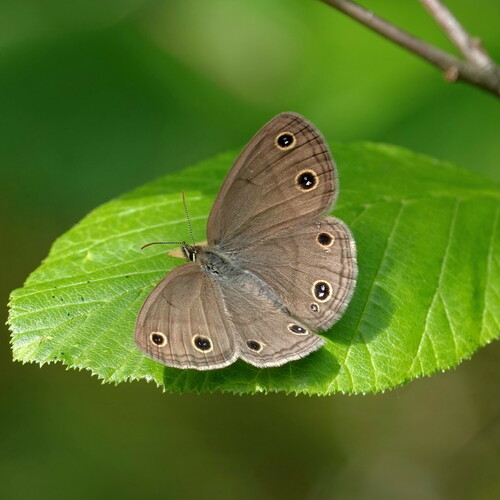
Adults of Euptychia cymela Cramer, 1779 (Little Wood Satyr) have a wingspan of 29–48 mm. The forewing has two black eyespots rimmed with yellow on both the dorsal and ventral sides. The hindwing has two spots on the dorsal side, and smaller spots on the ventral side. All other parts of the wings are light brown. While it has similar markings, the Little Wood Satyr is slightly larger than Hermeuptychia sosybius. The caterpillar has a light greenish brown body with a dark dorsal line, and alternating brown and yellowish lateral stripes. The caterpillar’s body has bumps, which bear short reddish-brown hairs. Its head is dirty white, and its tail hairs are light gray. The Little Wood Satyr is a member of the typically Neotropical subtribe Euptychiina. This species can be observed in forests, most often along forest edges and in brush-filled openings along cleared forest roads. It has also been found in grassy areas that sit between patches of forest. It flies close to the ground, twisting between and through grasses, small trees, and bushes. Collectors often find it difficult to capture, even though it appears to be a slow flyer at first glance. It prefers open habitats that contain deciduous trees, marshy areas, and brushy cover. The species occurs in eastern United States and southeastern Canada, ranging from Nova Scotia south to Florida, and west to Texas, Saskatchewan, and Wyoming. As its common name suggests, it is most commonly found in woods and shrubby areas. The subspecies Megisto cymela viola is often referenced; it has subtle visual differences from the nominal subspecies and occurs in the more southern areas of the species’ range, but there is ongoing disagreement over which populations should be classified as this subspecies. In the northern portions of its range, adults fly between June and July. In southern populations, adults fly between March and September. Adults have a slow "bouncing" flight pattern, but they can fly as high as the tops of tall trees. Females lay eggs singly on grass blades or at the base of tree trunks. Fourth-instar caterpillars hibernate in leaf litter and emerge in May. They continue feeding through their final instar, then pupate for 8 days.