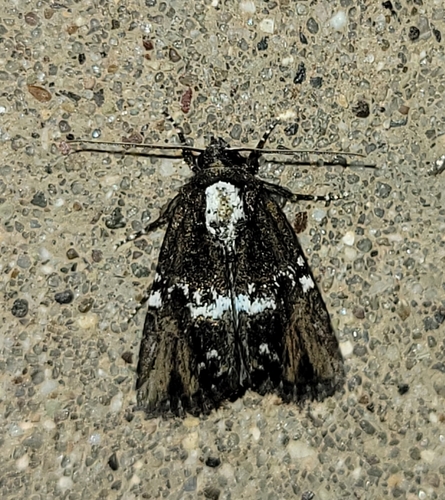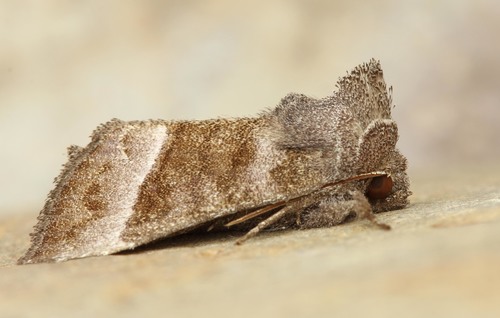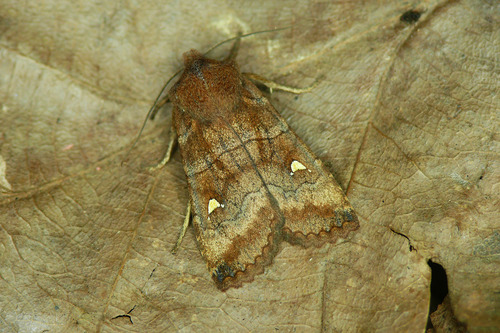
About Eupsilia transversa Hufnagel, 1766
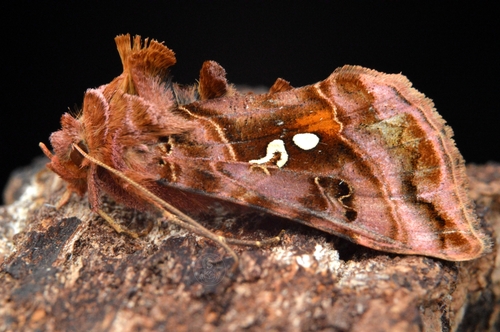
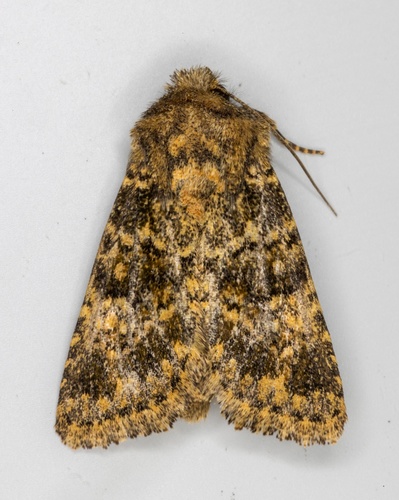
Technical description and variation: The forewing is grey-brown, with deeper suffusion. The inner and outer lines are fine, more or less erect; the inner line is straight, and the outer line is waved. There is a bent median shade, one shade located before the inner line, and another shade located just beyond the outer line. The submarginal line is pale and interrupted, preceded and followed by dark shades. The claviform and orbicular stigmata are obsolete. In the type form, the reniform stigma is orange yellow, with a white dot above and below it. The fringe matches the surrounding wing color, and is preceded by pale marginal lunules. The hindwing is fuscous brown. Linne's type form, which displays a yellow reniform stigma with two white dots, especially paired with a grey-brown ground color, is distinctly rare. As a general rule, when the reniform is yellow, the upper, and often also the lower, of the two dots tends to become yellow as well. When all three spots are deep reddish orange, this is the form brunnea Lampa. The form albipuncta Strand has a white reniform stigma, and its dots are also always white. The name rufescens Tutt, used for forms where the ground color has more or less of a rufous tinge, applies to the more common European form as well as the British form.
Distribution: This species ranges from Ireland to Japan. Specifically, its range extends south to northern Spain, Sardinia, central Italy, then through North Macedonia and Bulgaria to Asia Minor and the Caucasus, east through Central Asia, the Russian Far East and Siberia before reaching Japan. To the north, its range extends to Scotland and the Orkney Islands. Individuals have been reported in Iceland. In Fennoscandia, the range extends close to the Arctic Circle and includes northern Russia. This species is very tolerant of cold temperatures, and occupies a very wide variety of habitats, including open grasslands, forests, mountains up to 1800 m in the Alps, and subarctic tundra.
Recorded food plants: See Robinson, G. S. et al.