About Euproctis chrysorrhoea Linnaeus, 1758
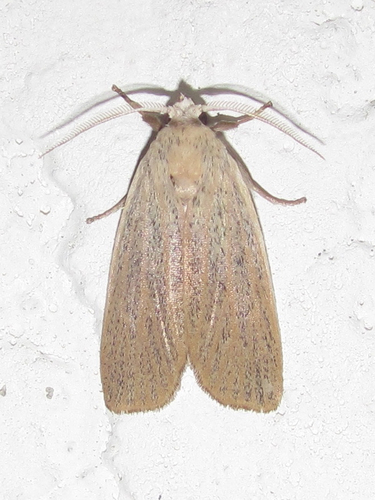
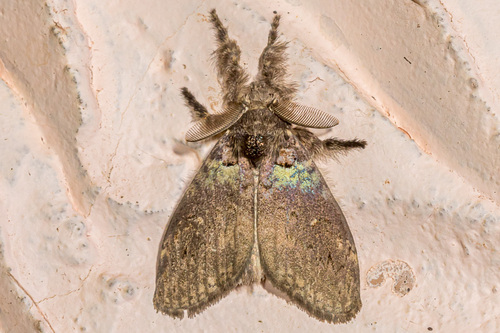
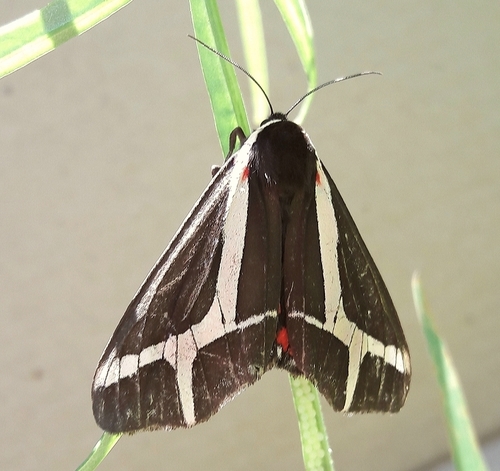
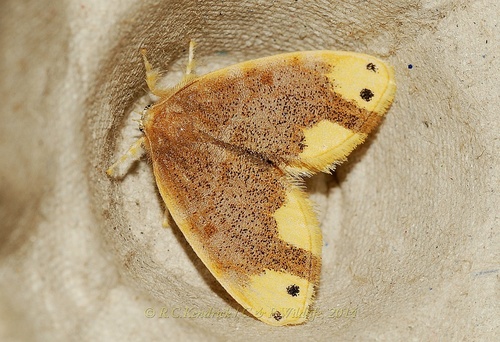
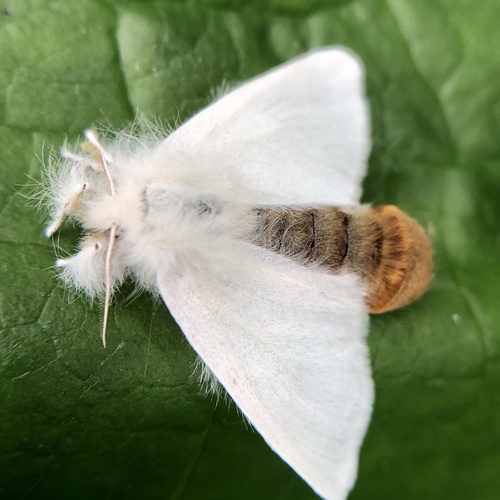
This moth species, Euproctis chrysorrhoea Linnaeus, 1758, has pure white upper wing surfaces. Males may have brown coloration on the underside of their forewings, and their wingspan ranges from 36 to 42 millimeters (1.4–1.7 in). The body is very hairy and mostly white, except for the tail, which is covered in reddish-brown hairs. This reddish-brown tail hair marking is far more prominent in females than males. Males have larger antennae, which they use to detect pheromones released by unmated females, and females have larger overall body size. As winged adults, this species is superficially similar in appearance to two other moths: European native Euproctis similis and North American native Hyphantria cunea. However, female E. similis have a yellow tail tuft, and H. cunea has no colored tail tuft at all.
Females lay a single cluster of 200 to 400 eggs, usually on the underside of a leaf. The entire egg cluster is covered with hairs taken from the female’s anal tuft. The larva is very hairy, brown with white markings, and has two prominent red spots toward its tail end. The larva’s hairs protect it from predators, and the larva incorporates some of these hairs into the cocoon where it pupates. This species overwinters communally as larvae inside a tough, silken tent built around branch-tip leaves and anchored to twigs. In areas where this species is abundant, these tents are a common sight, and can be found on a very wide range of plants, especially in late fall and winter when non-affected leaves have fallen.
The brown-tail moth produces one generation per year, with four distinct life stages: egg, larval, pupal, and adult. Eggs are laid in July and hatch in August. The annual life cycle divides as follows: approximately one month spent in the egg stage, nine months spent as larvae, one month spent as pupae, and one month spent as imagoes, which are winged, sexually mature adults. Females prefer to lay eggs on oak trees.
Pre-diapausing larvae emerge and feed gregariously starting in August, after about three weeks of egg incubation. In response to shorter daylight periods, diapausing larvae build communal winter nests in fall, and overwinter inside these nests. The nests are made of webbing that binds leaves together at tree-top branch tips. This winter nesting behavior is distinct from that of other communal moth larvae such as the eastern tent caterpillar, which overwinter as eggs, then build webbed nests in branch crotches during spring and summer.
Post-diapausing gregarious larvae emerge at about one centimeter long, and resume feeding in early April synchronized with bud break. They still use their winter nests as resting places, or construct new communal web-nests. These small larvae may also detach from trees and fall to the ground, then search for new host trees. Once larvae reach late instars, colonies break up and larvae become dispersive and start feeding independently. After six to eight instars, larvae pupate in June. Winged, sexually mature adult imagoes emerge about one month later, then mate, lay eggs, and die.