About Eupoecila australasiae (Donovan, 1805)
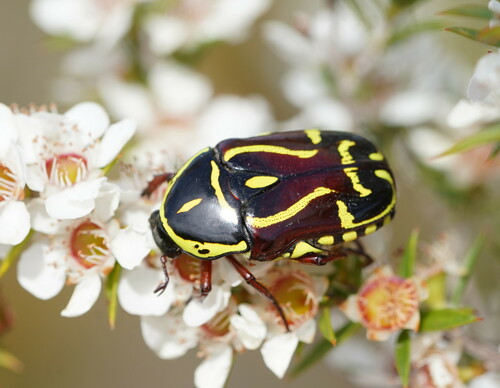
Eupoecila australasiae, commonly called the fiddler beetle or rose chafer, is a colourful green- or yellow-and-black scarab beetle native to eastern Australia. It was first described in 1805 by Anglo-Irish naturalist Edward Donovan, who named it Cetonia australasiae in his work An Epitome of the Natural History of the Insects of New Holland, New Zealand, New Guinea, Otaheite, and other Islands in the Indian, Southern, and Pacific Oceans. In 1842, German entomologist Hermann Burmeister reclassified it into the new genus Eupoecila, where it became the genus's type species. It belongs to the flower chafer subfamily Cetoniinae within the scarab beetle family.
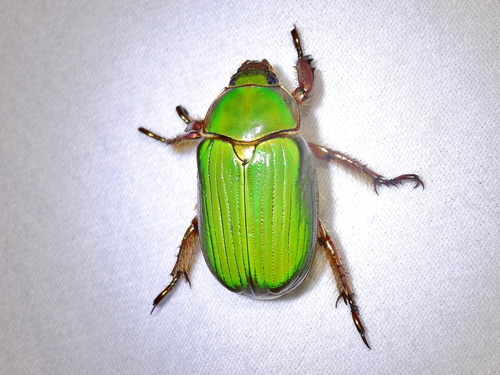
Fiddler beetles are strong fliers that can fly without moving their wing covers (elytra), and they spend much of their time searching for nectar and plant exudates. Their common name comes from their body pattern, which resembles a violin. Adult fiddler beetles measure 15–20 millimetres (0.6–0.8 in) long, with bodies patterned dark brown with lime green to yellow markings.
This species is distributed across eastern Australia, occurring in Queensland, New South Wales, Victoria, and southeastern South Australia. It inhabits heathland, eucalypt woodland, and also suburban parks and gardens. Females lay eggs in rotting logs, organic debris, or soil. Larvae feed on rotting wood until they mature, then pupate inside the wood by forming a cocoon-like chamber. Adult beetles burrow up through the soil and emerge in early summer, feeding on nectar-rich flowers, including Angophora hispida, A. woodsiana, Backhousia citriodora, and Melaleuca linariifolia.