About Euploea sylvester (Fabricius, 1793)
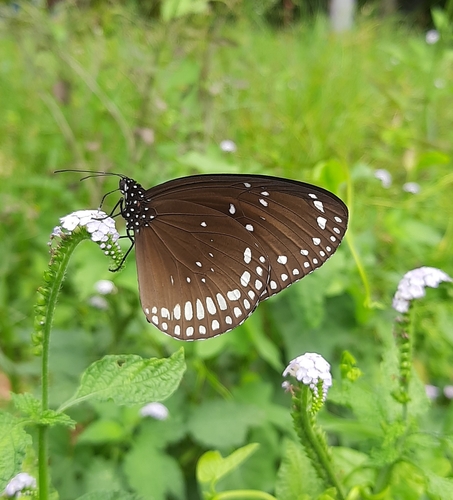
Euploea sylvester (Fabricius, 1793) very closely resembles Euploea core in overall shape, coloration, and markings. Males of this species can be distinguished from E. core immediately by having two brands on the forewing, rather than the single brand found on E. core males. According to Lionel de Nicéville, female E. sylvester (referred to here as E. coreta in the original text) can be separated from female E. core by three consistent traits. First, the outline of the forewing in E. sylvester females is more entire, while that of E. core females is slightly but noticeably scalloped. Second, the underside of the E. sylvester forewing has a complete series of six spots, with one spot located between each pair of nervules outside the wing cell; in E. core, two of these spots, specifically those above the discoidal nervules (veins 5 and 6), are always absent. Third, the two brands found in the male forewing's interno-median area (interspace 1) can be faintly but clearly seen in the same position on female E. sylvester. Euploea sylvester, commonly known as the double-banded crow, uses a range of plants from three families as larval food sources. These include plants in the Apocynaceae (dogbane and oleander) family: Parsonsia, Hoya, Cynanchum, Gymnema sylvestre, and Ichnocarpus frutescens; plants in the Asclepiadaceae (milkweed) family: Marsdenia; and plants in the Moraceae (fig) family: Ficus obliqua, Ficus microcarpa, and Ficus racemosa.