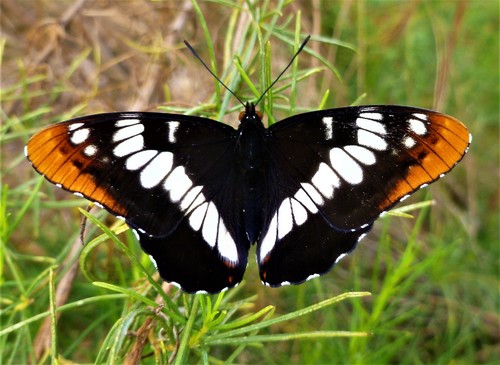
About Euploea crameri Lucas, 1853
Euploea crameri Lucas, 1853, commonly called the spotted black crow, has the same wing shape as Euploea godarti Lucas. Its upperside is a very dark brown that is almost black, with barely any lightening toward the terminal wing margins. Both forewings and hindwings have subterminal and terminal series of white spots. On the forewing, spots in the subterminal series are much larger than spots in the terminal series, and curve inward opposite the wing apex. A spot at the apex of the forewing cell is often obsolescent, and the forewing has a discal series of four or five spots, where one or two of these spots may be very small or obsolescent. On the hindwing, spots in the subterminal and terminal series are nearly equal in size. The underside of the wings is chocolate-brown, with the same pattern of white spots visible on the upperside, though the spots are more distinct on the underside. The hindwing additionally has a spot at the apex of its cell, and five or six small discal spots beyond this cell spot. Antennae, head, thorax, and abdomen are very dark brown; except for the antennae, these body parts are marked with white spots on their undersides. This species has a wingspan ranging from 88 to 94 mm. It occurs within the Indomalayan realm, and is known to make seasonal migrations.