About Euploea core (Cramer, 1780)
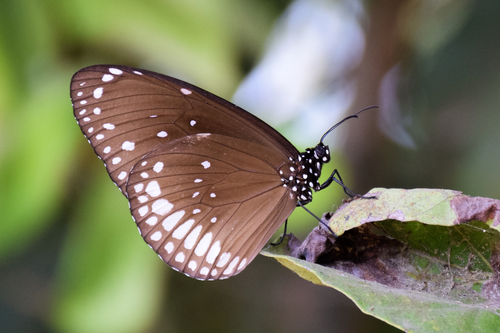
Euploea core (Cramer, 1780), commonly called the common crow, is a glossy-black butterfly with brown undersides and white markings along the outer margins of both wings. Its wingspan measures approximately 8–9 cm, and its body has prominent white spots. Males have a velvety black patch near the rear edge on the upperside of the forewing; a white streak sits in the same location on the underside, and this streak is present in both males and females. When the butterfly holds its natural resting position, the streak is hidden behind the hindwing, and can only be seen when the butterfly is captured and observed closely. An excerpt from Fauna of British India: Butterflies, volume 1 describes E. core as follows: Upperside dark brown, broadly paler along terminal margins; fore and hind wing have subterminal and terminal series of white spots; on the fore wing the former spots are more or less oval, curved inwards opposite the apex, and the latter series is often incomplete, not reaching the apex, with smaller spots; a small costal spot is often present, and very rarely a spot occurs in the apex of the cell and one or more discal spots; on the hind wing the inner series of spots are elongate, and the outer spots are conical. Underside is similar, but the ground-colour is more uniform; cell, costal and discal spots on both fore and hind wing are nearly always present. Race godarti (=E. godarti), found in Northeast India and Myanmar, differs from typical E. core in that its fore wing is subtriangular, with a more rounded tornus than in E. core, and its hindwing is broadly ovate. For race godarti: Upperside dark brown, broadly paler along the terminal margins, especially on the fore wing. Fore wing has a more or less incomplete and obsolescent series of subterminal and terminal small white spots, and a powdering of violaceous-white scales at the apex. The extent of this scaling varies considerably, from a mere trace of violaceous between the veins to a large, very conspicuous patch occupying the entire apex. Hindwing has a subterminal series of oval or inwardly conical white spots and a terminal series of more rounded white spots. Underside is paler brown, with larger, more clearly defined white spots. The fore wing apex is not violaceous; a spot (sometimes absent) occurs in the apex of the cell, along with two or three discal spots. On the hindwing: a spot in the apex of the cell, also sometimes absent, and a discal series of five small spots beyond. Antennae, head, thorax and abdomen are very dark brown; except for the antennae, these parts are sparsely spotted with white. E. core is distributed across southern Pakistan, Sri Lanka, India, Bangladesh, Myanmar, China, and Australia. Within its range, E. core occurs at all elevations, from sea level up into mountains to 2,400 metres (8,000 ft). It can be found in all layers of vegetation and in all types of regions, from arid land to forested areas. It is commonly seen gliding over treetops and flitting about a foot off the ground while searching for nectar-producing flowers. In thick forests, it is often seen moving along open tracks or following the course of a river. Because this butterfly is protected by being inedible, it has a leisurely flight pattern. It is often seen flying around shrubs and bushes searching for its host plants, and visits a large variety of flowering plant species. When gliding, E. core holds its wings at an angle just greater than the horizontal plane, and maintains flight with a few measured wingbeats. E. core prefers nectar and visits flowers unhurriedly, and appears to prefer flower bunches over individual flowers. When feeding, the butterfly moves slowly and is not easily disturbed, so it can be approached closely during this time. On hot days, large numbers of these butterflies can be observed mud-puddling on wet sand. E. core is an avid mud-puddler that often congregates in huge swarms alongside other Euploea species as well as other danaids. This butterfly also gathers on damaged parts of plants such as Crotalaria and Heliotropium to forage for pyrrolizidine alkaloids, which are chemical precursors used to produce pheromones. During courtship, male E. core release these sex pheromones to attract females. Once a female is in the vicinity, males glide around and disperse the scent into the air with the help of a pair of yellow brush-like organs that extend out from the tip of the abdomen. Along with other danaids such as the tigers, E. core is one of the most common migrating butterfly species. Equal proportions of males and females have been observed migrating. The common crow's larval food plants include a large number of species from the families Apocynaceae (dogbanes, milkweeds and oleanders), Moraceae (figs), Rubiaceae, and Ulmaceae. The specific recorded larval host species are: Aphananthe cuspidata, Asclepias curassavica, Asclepias guadeloupe, Asclepias syriaca, Calotropis gigantea, Carissa ovata, Cerbera manghas, Cryptolepis pauciflora, Cryptolepis sinensis, Cryptostegia madagascariensis, Cynanchum carnosum, Ficus benghalensis, Ficus benjamina, Ficus hederacea, Ficus microcarpa, Ficus obliqua, Ficus pandurata, Ficus platypoda, Ficus pyriformis, Ficus racemosa, Ficus religiosa, Ficus rubiginosa, Ficus variolosa, Gomphocarpus fruticosus, Gymnanthera oblonga, Hemidesmus indicus, Holarrhena pubescens, Hoya australis, Ichnocarpus frutescens, Leichhardtia rostrata (syn. Marsdenia rostrata), Leichhardtia suaveolens (syn. Marsdenia rostrata), Marsdenia australis, Nerium indicum, Nerium oleander, Parsonsia alboflavescens, Parsonsia straminea, Plumeria acuminata, Sarcostemma australe, Secamone elliptica, Streblus asper, Toxocarpus wightianus, Trachelospermum bowringii, and Tylophora indica. E. core larvae usually have some preference for certain species within a given geographic area. The most commonly used larval host plants are Ficus racemosa, Nerium oleander, Nerium odorum, and Cryptolepis buchananii. Ficus pumila, a cultivated garden climbing plant that grows on walls, has also been recorded as a larval host.