About Euplagia quadripunctaria (Poda, 1761)
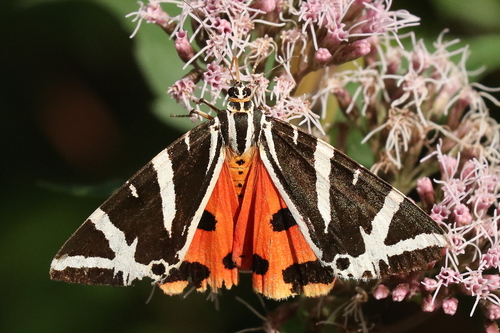
Euplagia quadripunctaria, commonly called the Jersey tiger or Spanish flag, is a day-flying moth in the family Erebidae. This species was first formally described by Nikolaus Poda von Neuhaus in 1761. Adult moths have a wingspan ranging from 52 to 65 millimeters, or 2.0 to 2.6 inches, and their flight period runs from July to September, which varies based on location. They typically fly close to hemp-agrimony, Eupatorium cannabinum. Across most of the species' range, aposematic adult moths have red underwings. In the northwestern portion of the range, adult underwing color is polymorphic, and can appear red, orange, or yellow. Caterpillars, the larval stage of this moth, are polyphagous generalist feeders. They feed from September to May on a range of host plants including nettles (Urtica), raspberries (Rubus), dandelion (Taraxacum), white deadnettle (Lamium), ground-ivy (Glechoma), groundsel (Senecio), plantain (Plantago), borage (Borago), lettuce (Lactuca), and hemp-agrimony (Eupratoria). The species overwinters as a small larva. Large groups of adults of the subspecies E. q. rhodosensis occasionally gather to aestivate, sheltering from summer heat, at the Valley of the Butterflies in Petaloudes on the island of Rhodes. Euplagia quadripunctaria has a wide distribution across Europe, ranging from Estonia and Latvia in the north, to southern Great Britain and France in the west, and the Mediterranean coast and its islands in the south. It can also be found in western Russia, the southern Urals, Asia Minor, Rhodes and its surrounding islands, the Near East, the Caucasus, southern Turkmenistan, and Iran. Individual moths are recorded migrating north from their regular breeding grounds during the summer months.