About Eupithecia tripunctaria Herrich-Schäffer, 1852
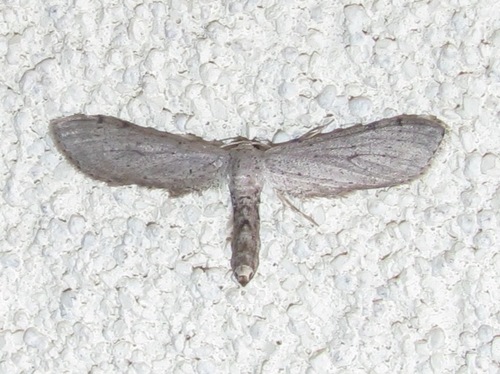
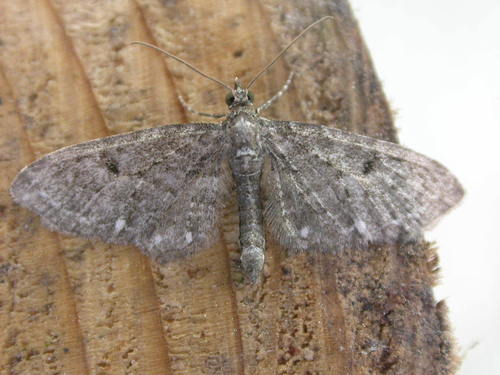
Eupithecia tripunctaria Herrich-Schäffer, 1852, has a wingspan of 17–21 mm. The ground colour of its wings ranges from ash grey to dark ashy brown to blackish; the hind wings are often slightly paler on average. A pale wavy line runs along the margin of both wings, with some sections broken into distinct, more prominent white marks. These white marks give the species its name. While the marks can appear on both wings, they are commonly absent from the hindwings. Though this is a useful identifying feature for the species, care must still be taken to distinguish it from other related species. Like other pug moths, Eupithecia tripunctaria has a black discal spot in the center of the forewings, although this spot is often hard to see. The melanistic form f. angelicata is uniformly smoky black, with no markings other than a deeper black cell-spot, and this form occasionally occurs in some populations. These entirely dark individuals are difficult to separate from other species. The egg of this species is oval in shape, with hexagonal depressions in its shell sculpture. Fully grown caterpillars are either greenish or brownish, and have very clear dark, heart-shaped, brightly framed spots on their back, with the tips of these spots directed forward. The brownish pupa has dark green wing sheaths, and the cremaster has two strong and six thin hook bristles. Adults are on wing from March to September, varying by location. The larvae feed on Apiaceae species. The species is distributed across the Palearctic realm, including Europe from central Scandinavia to the Alps, Russia, the Russian Far East, Siberia, Amur, and Baikal, extending east to Japan and the Kuril Islands. In the Pyrenees and the Alps, E. tripunctaria occurs up to an elevation of 1800 m above sea level. It also has a distribution range in North America, stretching from Newfoundland to British Columbia and the San Bernardino Mountains in Southern California. The species prefers lowland forests, forest edges and damp meadows.