About Eupithecia tantillaria Boisduval, 1840
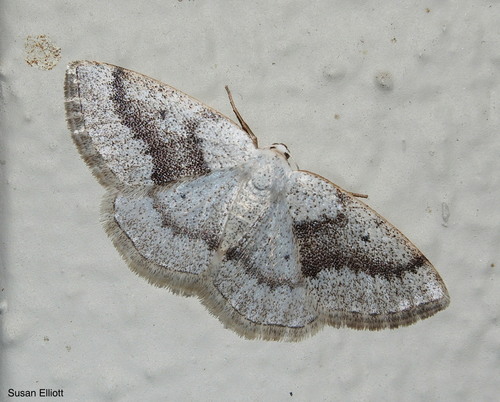
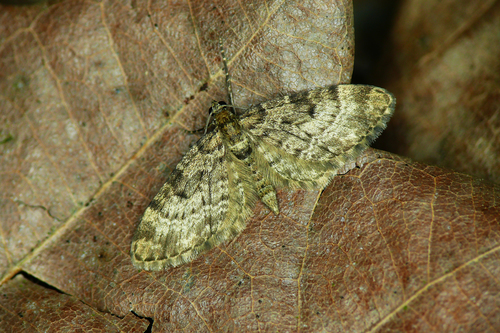
Eupithecia tantillaria Boisduval, 1840 has a wingspan of 16–19 millimetres (0.63–0.75 in). The forewings have a light grey ground colour, a distinct usually stretched discal spot, dark grey to brownish wavy crosslines that continue onto the hindwings, darker patches along the forewing costal edge, a paler white sub-marginal line, and a chequered wing fringe. Both forewings and hindwings are narrow. The hindwings are pale white with brown crosslines and a small black discal spot. Darker, less pattern-distinctive specimens of this species occur. Caterpillars are light brown to chocolate brown with a wide dark dorsal stripe; this colouration and pattern makes them resemble dead, dried-up needles, leaving them inconspicuous on their host trees and well protected from predators. Adult moths fly from April to July, with flight timing varying by location. Caterpillars feed on Norway spruce and other Pinophyta species, including fir, European larch, and Juniperus communis. The species' distribution ranges from western Europe and the British Isles east to Ukraine, Georgia, Russia, the Russian Far East, and the Altai Mountains. In Fennoscandia it reaches as far north as Sápmi, but it is not found on Iceland. Its southern range covers Italy, the Balkans, Turkey, Asia Minor, and the Caucasus. It is absent from southern and central Spain, Portugal, and the Mediterranean islands. In the Alps, it occurs up to the tree line.